
Science commentary · 2026-10-21 · Updated 2026-11-14
Is grass-fed whey lower in heavy metals? What the lab data shows (2026)
Grass-fed whey can have low heavy-metal readings, but the label is not a contaminant standard. Labdoor found lead below its limit of quantification in the grass-fed wheys we list except Transparent Labs isolate, at 0.16 µg per serving. Consumer Reports also measured conventional wheys below its 0.5 µg/day lead concern level. Different labs, lots and flavours prevent a like-for-like comparison; choose published results rather than the sourcing claim.


Grass-fed whey can have low heavy-metal readings, but the label is not a contaminant standard. Labdoor found lead below its limit of quantification in the grass-fed wheys we list except Transparent Labs isolate, at 0.16 µg per serving. Consumer Reports also measured conventional wheys below its 0.5 µg/day lead concern level. Different labs, lots and flavours prevent a like-for-like comparison; choose published results rather than the sourcing claim.
This is general information, not medical advice.
The short answer
- Grass-fed whey tests very low. Every grass-fed whey in our data with a Labdoor review measured lead below the limit of quantification (LOQ), except Transparent Labs' isolate at 0.16 µg per serving.
- Conventional whey tests low too. Consumer Reports measured Optimum Nutrition Gold Standard 100% Whey at 0.27 µg lead, BSN Syntha-6 at 0.23 µg and Walmart's Equate whey at 0.268 µg, all under CR's 0.5 µg/day level of concern [1].
- The gap is mostly about who tested, and how. The grass-fed results come from Labdoor; the conventional ones from CR. Different labs, lots, flavours and reporting rules, so it isn't a like-for-like comparison.
- Milk is a poor route for metals. In a classic dairy-cow feeding study, cadmium didn't appreciably rise in milk even at high doses, and low dietary exposures didn't appreciably raise lead or cadmium in milk.
- What matters more: flavour (cocoa), added plant ingredients, serving size, and whether the brand publishes lot-level results.
Our lab-verified picks

10.0/10 safety
COAMomentous
Essential Grass-Fed Whey Protein Isolate
Vanilla · 25 g serving
Best for · Joint lowest heavy metals of 34 rated
Lead: too small to measure
20 g protein per scoop · Complete protein
$69.99 · updated 22 Nov
Lab details & evidence ▾
Heavy metals
µg/serving · independent test, not scored. ND = not detected; below LOQ = too small to measure; iAs = inorganic arsenic.
Metals score 10.0/10 · measured against Prop 65 (California's daily safe limit)
Protein quality
Complete
- Protein:
- Whey protein isolate (grass-fed)
- Completeness:
- Complete — Whey isolate; complete (PDCAAS 1.0).
- Completeness score:
- 10.0/10 — typical value for whey protein isolate (DIAAS 1.09, Rutherfurd et al. 2015, J Nutr 145:372)
Sources
- Independent test (not scored):
- Brand-published COA (heavy metals by ICP-MS, SGS) · checked 2026-10-29
- Evidence:
- Current Momentous whey isolate (sold as Essential Whey / Grass-Fed Whey Protein Isolate, in stock on livemomentous.com and Amazon B09F1SWMFG, Vanilla, checked 29 Oct 2026). Momentous COA Vanilla lot 0309B6 (mfg 7 Apr 2026, tested 20 Apr 2026): lead, cadmium, arsenic and mercury all <0.250 µg per 25 g scoop (below reporting limit; not quantified ≠ zero). Unflavored lot 0241H6A (Light Labs, 1 Sep 2026): Pb <0.050, Cd <0.003, Hg <0.020, As 0.050 µg per 23.7 g scoop. Distinct from the CR-tested Momentous Whey Protein Isolate Vanilla (26.5 g serving) that Momentous told CR was discontinued; that entry stays in the archive.

10.0/10 safety
COAPuori
PW1 Grass-Fed Whey Protein
Bourbon Vanilla · 30 g serving
Best for · Joint lowest heavy metals of 34 rated
Lead: too small to measure
21 g protein per scoop · Complete protein
$79.00 · updated 22 Nov
Lab details & evidence ▾
Heavy metals
µg/serving · independent test, not scored. ND = not detected; below LOQ = too small to measure; iAs = inorganic arsenic.
Metals score 10.0/10 · measured against Prop 65 (California's daily safe limit)
Brand-published test: Puori-published Clean Label Project COA, Bourbon Vanilla batch BO254497 (Ellipse Analytics, 17 Sep 2026): Pb, Cd, As, Hg all ND per 30 g serving (counted as 0).
Protein quality
Complete
- Protein:
- Whey protein concentrate (pasture-raised)
- Completeness:
- Complete — Whey protein concentrate; complete amino acid profile.
- Completeness score:
- 10.0/10 — typical value for whey protein isolate (DIAAS 1.09, Rutherfurd et al. 2015, J Nutr 145:372)
Sources
- Independent test (not scored):
- Clean Label Project certification COA (Ellipse Analytics), published by Puori · checked 2026-10-26
- Evidence:
- Puori publishes a Clean Label Project certification COA for every PW1 batch. Bourbon Vanilla batch BO254497 (Ellipse Analytics, 17 Sep 2026): lead, cadmium, arsenic and mercury all ND (µg/serving); protein 20.21 g measured vs 21 g claimed. The newest batches (BO254494–BO254497 Vanilla, 260828A Dark Chocolate, Oct 2026) are also all ND. The COA does not state detection limits; ND ≠ zero. 30 g serving per Puori's amino-acid panel. Buy link (2026-11-07): Puori partner URL https://puori.com/SFKDMGMV (replaces Amazon ASIN B0736B62K5 on cards). No Consumer Reports or Labdoor test.
9.4/10 safety
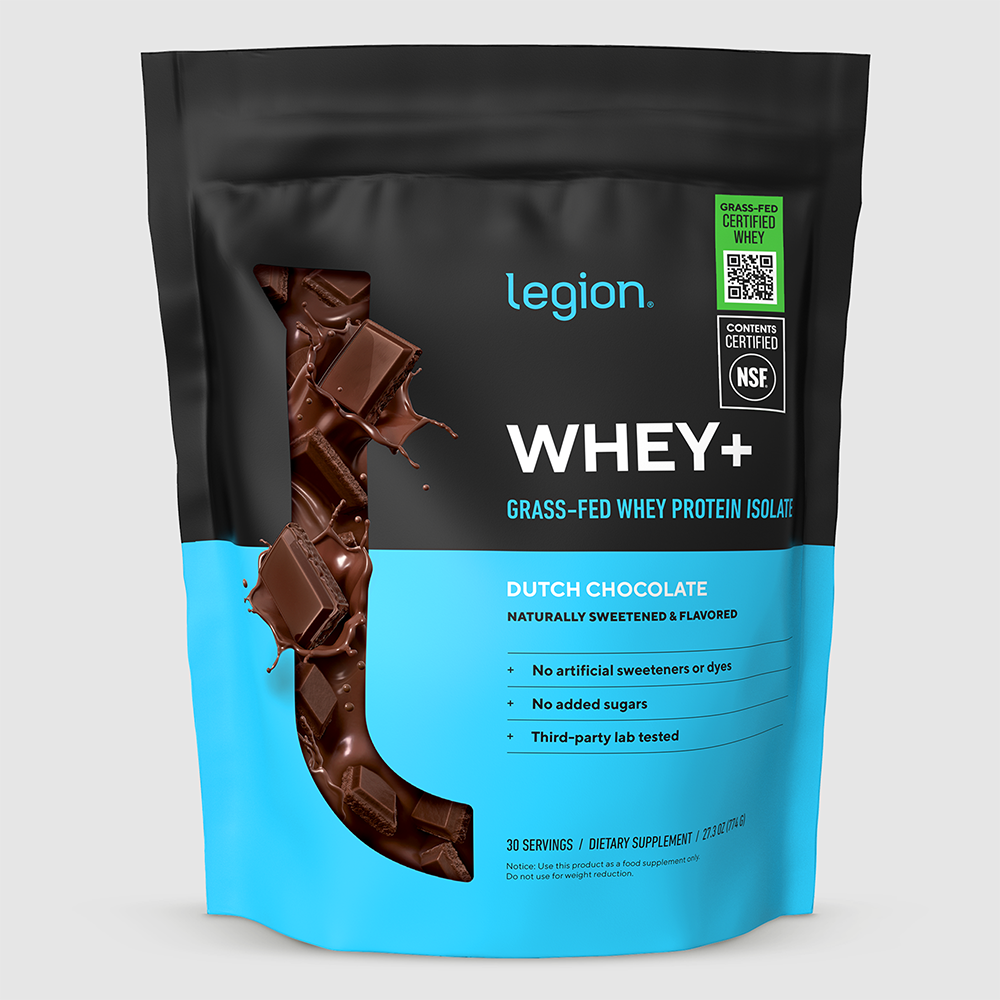
COALegion
Whey+ Whey Protein Powder
Varies · 1 scoop serving
Best for · #5 lowest heavy metals of 34 rated
Lead: too small to measure
22.5 g protein per scoop · Complete protein
$54.99 · updated 22 Nov
Lab details & evidence ▾
Heavy metals
µg/serving · independent test, not scored. ND = not detected; below LOQ = too small to measure; iAs = inorganic arsenic.
Metals score 9.4/10 · measured against Prop 65 (California's daily safe limit)
Brand-published test: Legion COA, lot 2623152: Cd 0.01 ppm × 26 g; Pb/As (<0.01 ppm) and Hg (<0.001 ppm) below LOQ (counted as 0).
Protein quality
Complete
- Limiting amino acid:
- None (histidine is the closest to the reference level)
- Metric:
- DIAAS 1.09 · PDCAAS 1.00 (DIAAS/PDCAAS are lab scores for protein quality; 1.0 is the top)
- Rich in:
- Leucine 2.41 g, lysine 2.34 g, threonine 1.56 g per serving; 5.6 g BCAAs, 12 g EAAs (brand data)
- Low in:
- None below reference; histidine is the lowest relative to need
Source: Brand data (amino-acid profile on product page) · score basis: Typical for whey protein isolate (published studies: DIAAS 1.09, PDCAAS 1.00, Rutherfurd et al. 2015)
- Protein:
- Whey isolate (grass-fed)
- Completeness:
- Complete — Whey isolate; complete (PDCAAS 1.0).
- Completeness score:
- 10.0/10 — typical value for whey protein isolate (DIAAS 1.09, Rutherfurd et al. 2015, J Nutr 145:372)
Sources
- Independent test (not scored):
- Labdoor / third-party lab COA (ICP-MS) · checked 2026-03-06
- Evidence:
- Labdoor review 6 Mar 2026: 22.5 g protein measured vs 22 g claimed; lead, cadmium, arsenic and mercury all below limit of quantification. Not quantified ≠ zero; methods differ from CR.
- Price:
- ≈ $1.90/serving · 11.8 g protein per $ (approx., verify at checkout)
What "grass-fed" actually means on a whey tub
There's no federal definition to lean on. USDA's Agricultural Marketing Service withdrew its voluntary grass (forage) fed marketing standard in January 2016, saying it lacked the authority to define such claims, and that standard never covered dairy [3]. Brands now rely on their own sourcing claims or on third-party programmes such as the American Grassfed Association's dairy standard, which sets rules for forage diets and pasture access.
None of these is a contaminant test. Like the organic seal, grass-fed describes how the animals were raised, not how much lead ended up in the finished powder.
The lab data: grass-fed vs conventional whey
Grass-fed whey (Labdoor reviews)
- Legion Whey+ (grass-fed isolate): lead, cadmium, arsenic and mercury all below LOQ; 22.5 g protein measured (March 2026).
- Muscle Feast 100% Whey (grass-fed concentrate, isolate and hydrolyzed blend): all four metals below LOQ; 24.6 g protein (June 2026).
- Muscle Feast Grass-Fed Whey Isolate: all four below LOQ; 26.1 g protein (April 2026).
- Muscle Feast Grass-Fed Whey Concentrate and Whey Protein Hydrolyzed: all four below LOQ (January 2026).
- Transparent Labs 100% Grass-Fed Whey Isolate: 0.16 µg lead, 0.35 µg cadmium, 0.1 µg arsenic, mercury below LOQ; 28.12 g protein (August 2026).
Conventional whey and dairy blends (Consumer Reports)
- BSN Syntha-6 (whey, casein and milk protein blend): 0.23 µg lead, cadmium not detected, 0.2 µg arsenic per 47 g serving.
- Equate Whey Protein, Rich Chocolate (Walmart): 0.268 µg lead, 0.217 µg cadmium (January 2026).
- Optimum Nutrition Gold Standard 100% Whey, Double Rich Chocolate: 0.27 µg lead, 0.24 µg cadmium, 0.16 µg arsenic.
- Premier Protein powder, Chocolate Milkshake: 0.38 µg lead, 0.649 µg cadmium (January 2026).
So every whey on both lists is under 0.5 µg lead per serving. For comparison, CR found plant-based products averaged about nine times the lead of dairy-based ones, and its highest results were plant powders such as Huel Black Edition (6.31 µg) and Naked Nutrition Vegan Mass Gainer (7.7 µg) [1].
Why the comparison isn't apples to apples
- Below LOQ isn't zero. It means Labdoor's lab couldn't quantify a value. CR reports measured averages, including very small ones. A powder at "below LOQ" and a powder at 0.23 µg may be closer than they look (how the two testers differ).
- Flavour differs. CR's January 2026 follow-up tested chocolate only, and the 2025 Optimum Nutrition sample was Double Rich Chocolate. Cocoa is a known source of lead and cadmium (the data), and the cadmium readings above track that: Premier's chocolate powder at 0.649 µg sits well above BSN's vanilla, where cadmium wasn't detected.
- Lots differ. Labdoor's results are usually single lots; CR averaged several lots per product.
- Formats differ. Several grass-fed picks are isolates, which carry less non-protein material per scoop than blends with added carbs, fats or cocoa. See isolate vs concentrate vs plant.
Why metals barely reach milk
Cows do take in lead and cadmium from soil, pasture and feed, whether they graze or eat grain. But milk is a poor carrier. In a Journal of Dairy Science feeding study, lactating cows given cadmium for three months accumulated it mainly in the liver and kidneys, and it didn't appreciably increase in milk [2]. Lead in milk did rise at the highest dose, but the authors found low dietary exposures didn't appreciably raise either metal in milk or meat.
That helps explain why dairy proteins as a group test low, and why the cows' diet is unlikely to be the main lever. Grazing animals can also swallow soil along with grass, so pasture isn't automatically a lower-metal diet. We haven't found any published study that directly compares heavy metals in grass-fed and conventional whey powder.
So why do grass-fed brands rank so well?
Partly because they're the ones getting tested in public. Legion, Muscle Feast and Transparent Labs all have current Labdoor reviews, and Transparent Labs is one of only two brands that told CR it posts heavy-metal results on its website. Transparency and grass-fed sourcing tend to come from the same premium brands, so the label correlates with good data without causing it.
There are other reasons people choose grass-fed whey, from animal welfare to sourcing preferences. Those are fair reasons. Lower heavy metals just isn't one the evidence can claim yet.
How to pick a low-metal whey, grass-fed or not
- Look for a number, not a claim. A µg-per-serving result from CR, Labdoor or a lot-specific COA beats any front-of-pack label (how to read a COA).
- Choose vanilla or unflavoured when you can, to avoid cocoa's extra lead and cadmium.
- Prefer straight whey or isolate over blends packed with plant ingredients or carbs.
- Count your scoops. Two servings double the metals (daily serving limits).
- Skip mass gainers for daily use. Their 190–360 g servings change the maths (why).
All of the whey and dairy powders above are complete proteins with all nine essential amino acids (completeness explained). For a ranked shortlist, see our best daily whey picks.
References
- Consumer Reports. Protein powders and shakes contain high levels of lead
- Journal of Dairy Science. Dietary lead and cadmium in lactating cows
- USDA AMS. Withdrawal of voluntary grass-fed marketing standard
FAQ
Is grass-fed whey lower in lead than regular whey?
In our data, grass-fed wheys tested at or below Labdoor's limit of quantification, while conventional wheys tested at about 0.23–0.38 µg in Consumer Reports' work. Both are low, and the results come from different labs and flavours, so the evidence doesn't show that grass-fed sourcing itself lowers lead.
What is the cleanest grass-fed whey protein?
Legion Whey+ and Muscle Feast's grass-fed whey range had lead, cadmium, arsenic and mercury all below Labdoor's LOQ. Transparent Labs Grass-Fed Whey Isolate measured 0.16 µg lead with 28.12 g protein. Check the live order on our rankings.
Is there a legal definition of grass-fed whey?
Not in the US. USDA withdrew its voluntary grass-fed marketing standard in 2016, and it never applied to dairy. Third-party programmes such as the American Grassfed Association set their own dairy rules, but none sets a heavy-metal limit.
Is conventional whey safe for daily use?
CR listed several conventional powders as better for daily use, including Optimum Nutrition Gold Standard (up to 1¾ servings a day), Equate (1¾) and Premier Protein (1⅓). Follow the serving limit for the product you buy.
Does grass-fed whey have fewer heavy metals than plant protein?
Generally yes, but that's because it's whey, not because it's grass-fed. CR found dairy products averaged far less lead than plant-based ones.
Compare every product on lead, cadmium, arsenic and protein completeness on our rankings, or go straight to in-stock picks in the shop. Affiliate status never changes rank. As an Amazon Associate I earn from qualifying purchases.
Related articles
Is organic protein powder lower in heavy metals? What the lab data shows
2026-10-07
Organic sounds cleaner, but in the largest protein powder study to date, certified organic powders averaged three times the lead of non-organic ones. Here's why the seal doesn't limit metals, and how to shop for genuinely low lead.
Protein bars vs powder: which format is cleaner on heavy metals?
2026-11-11
Clean Label Project’s 2025 snack/nutrition bar study found detectable heavy metals in every bar tested, with about 22% over Prop 65 lead. Consumer Reports’ powder/shake round is a different format. When a scoop with a lot COA is the cleaner daily default.
How fresh should a protein powder COA be? Lot testing explained
2026-11-11
FDA dietary-supplement CGMPs require contamination specifications and finished-batch verification every batch or via a sound statistical sampling plan — not a single forever COA. How to match lots, why results drift, and a buyer checklist.
As an Amazon Associate I earn from qualifying purchases. Affiliate status never changes rank. 0 paid placements.