
Buying guide · 2026-11-11 · Updated 2026-11-11
Protein bars vs powder: which format is cleaner on heavy metals?
Clean Label Project’s 2025 snack/nutrition bar study found detectable heavy metals in every bar tested, with about 22% over Prop 65 lead. Consumer Reports’ powder/shake round is a different format. When a scoop with a lot COA is the cleaner daily default.

The short answer
Protein bars and protein powders are different matrices — do not treat one lab round as covering both. Clean Label Project’s May 2025 snack and nutrition bar study (165 products) reported detectable heavy metals in every bar, with about 22% over California Prop 65’s lead level and about 6% over the cadmium level [1][2]. Consumer Reports’ 2025 protein investigation covered powders and ready-to-drink shakes, not bars, and found plant powders averaging about nine times the lead of dairy powders [3]. For daily protein with a verifiable µg row, a dairy powder with a lot-matched COA on our rankings is usually the cleaner controllable choice [4]. Not medical advice.
Why format comparisons get muddled
Search results often mash “protein” into one contaminant story. Bars add nuts, seeds, cocoa, rice crisps, syrups and coatings on top of a protein blend; powders are mostly a filtered protein base plus flavour system. That ingredient stack changes both taste and the plausible metal contributors — cocoa is a recurring lead/cadmium story in chocolate products [5]. Format also changes serving size: a 60 g bar is not a 30 g scoop, so µg per serving and µg per 20 g protein can rank differently.
We already normalised shakes vs powders on lead per gram of protein (shakes vs powder). This page is the bar vs powder fork: what the largest recent bar screen shows, what powder/shake screens show, and how to shop without inventing a head-to-head that no single lab published.
What Clean Label Project measured in snack and nutrition bars
CLP’s 2025 bar study is a category screen of bars — not a powder ranking. The public report summary states Clean Label Project tested 165 snack and nutrition bars from 50 top-selling brands (described as representing about 85% of the market) [1]. Key published findings:
- Every tested product had detectable heavy metals [1][2]
- About 98% had detectable lead; 36 bars (~22%) were over California Prop 65 lead limits [1]
- About 98% had detectable cadmium; 10 bars (~6%) were over Prop 65 cadmium limits [1]
- The bottom quartile averaged more than three times the heavy-metal concentration of the top quartile [1]
- Organic bars averaged about 28% higher heavy-metal concentrations than conventional bars [1]
- Bars labelled for kids were nearly a third lower in heavy metals than bars not labelled that way, on average [1]
Trade coverage of the same study repeats the 100% detectable / ~22% lead / ~6% cadmium headline rates [2]. CLP’s “Clean Sixteen” lowest-contaminant shortlist is a relative peer ranking inside that bar set — not a claim those SKUs are metal-free, and not a powder score [6]. Organic seals are not a metals pass in powders either (organic metals; myths).
What Consumer Reports measured in powders and shakes
CR’s headline protein round is powders + RTD shakes. The 2025 investigation reported more than two-thirds of tested products above CR’s 0.5 µg/day lead concern in a single serving, with plant-based products averaging about nine times the lead of dairy-based ones [3]. The January 2026 follow-up again named low-lead powder options (including store-brand Equate whey at 0.268 µg lead) [7]. That dataset answers “which scoop/bottle,” not “which bar.”
Powder shopping still needs brand COAs for our metals scores — CR figures are context on cards (how we score; ON Gold Standard review).
Why bars can diverge from powder even with the same “protein” word
| Factor | Typical powder scoop | Typical protein bar |
|---|---|---|
| Matrix | Protein concentrate/isolate + flavour system | Protein + nuts/seeds + binders + often cocoa coating |
| Serving mass | Often ~25–40 g | Often ~40–70 g |
| Cocoa exposure | Optional (flavour choice) | Common in chocolate/brownie SKUs |
| Independent category screens | CR 2025 powders/shakes [3]; CLP protein study [8] | CLP 2025 snack/nutrition bars [1] |
| Our board | Scored when brand publishes µg/serving metals | No protein-bar SKUs scored today |
Cocoa is a practical divider for shoppers who already worry about chocolate powders (is chocolate dirtier?). A plain dairy scoop you flavour yourself keeps cocoa optional; many convenience bars bake cocoa into the product. Nuts and seeds can also move cadmium/lead stories because plants take metals from soil — the same plant-uptake logic behind higher plant-powder averages [3][8]. We do not invent per-bar µg tables here beyond what CLP summarised at category level.
How Prop 65 MADLs apply to either format
California Prop 65 oral MADLs we use on powder cards include lead 0.5 µg/day and cadmium 4.1 µg/day [4]. Those are daily safe-harbor warning yardsticks, not a claim that every exceedance is illegal or that FDA banned the product. A bar serving and a powder scoop both count toward the same day’s total if you eat both. That is why stacking a high-lead bar on top of a plant powder can matter even when each package looks “normal” alone (lead in food vs powder).
When a powder is the cleaner daily default
Use a scored dairy powder when:
- You want µg-per-serving evidence tied to a lot (COA guide; same-day COA freshness / lot testing guide on the journal index once live).
- You can control flavour (vanilla/unflavoured vs chocolate).
- You care about repeat daily scoops more than grab-and-go packaging.
Starting shortlist from our board (dairy; metals first):
| Product | Metals score | Why it appears here |
|---|---|---|
| Puori PW1 Bourbon Vanilla | 10.0 | Brand four-metal COA on scored lot |
| Momentous Essential Whey | 10.0 | Brand COA below reporting limits on scored lots |
| Legion Whey+ | 9.4 | Brand COA + Labdoor context |
If you need plant powder instead, use the plant low-lead shortlist — do not assume a “clean” bar wraps the same base. Affiliate status never changes sort order (independence).
When a bar still makes sense
Bars win on travel and adherence, not on metals transparency. If you keep bars:
- Prefer brands that publish lot-level Pb/Cd/As/Hg panels for that SKU (rare compared with powders on our board).
- Treat chocolate/cocoa bars as a higher-scrutiny flavour class [5].
- Do not read CLP’s Clean Sixteen as a metals zero [6].
- Count the bar toward the same daily lead budget as your shakes (how many scoops / lead).
Homemade bars from a known powder, nut butter and dried fruit shift control back to the powder’s COA — that is a recipe strategy, not a scored product claim.
Browse more guides in the journal. As an Amazon Associate I earn from qualifying purchases.
Bottom line
CLP’s 2025 bar screen found detectable metals in all 165 bars, with roughly one in five over Prop 65 lead [1][2]. CR’s powder/shake investigation is the better cited source for scoops and bottles, with dairy usually lower than plant for lead [3][7]. Formats are not interchangeable lab categories. For daily protein with published µg data, start from scored powders on our rankings [4].
FAQ
Did Consumer Reports test protein bars for lead?
No. CR’s 2025 protein investigation covered powders and ready-to-drink shakes [3]. Use CLP’s bar study for bar-category context [1].
Are protein bars dirtier than whey powder?
Category screens are not a paired SKU duel. CLP’s bar set shows widespread detectable metals and a large top-vs-bottom spread [1]; CR’s dairy powders include many options under 0.5 µg lead per serving [3][7]. Compare products, not slogans.
Does organic mean a cleaner bar?
Not in CLP’s bar averages — organic bars ran about 28% higher in heavy metals than conventional ones [1]. Same caution as organic protein powder.
Should I stop eating protein bars?
Not automatically. Limit frequency if metals are your main worry, prefer transparent lot data, and keep daily protein on a scored powder when you can [1][4].
Why don’t you rank protein bars on the board?
We score brand-published usable metal panels for products in our powder/shake dataset. No bar SKU currently meets that bar for a metals score.
Is this medical advice?
No. It is format-literacy and cited lab-context for shoppers.
References
- Clean Label Project. U.S. Snack and Nutrition Bars study PDF (May 2025)
- NutritionInsight. Clean Label Project flags contaminants in snack and nutrition bars
- Consumer Reports. Protein powders and shakes contain high levels of lead (2025)
- OEHHA. Current Proposition 65 NSRLs and MADLs
- Consumer Reports. Lead and cadmium in dark chocolate (2023 investigation hub)
- Clean Label Project. Snack and nutrition bars — tested products / Clean Sixteen
- Consumer Reports. These five protein powders had low lead levels (January 2026)
- Clean Label Project. Protein Study (January 2025)
Products in this guide
Tracked buy links open in a new tab. Affiliate status never changes rank.
10.0/10 safety
COAPuori
PW1 Grass-Fed Whey Protein
Bourbon Vanilla · 30 g serving
Best for · Joint lowest heavy metals of 34 rated
Lead: too small to measure
21 g protein per scoop · Complete protein
$79.00 · updated 22 Nov
Lab details & evidence ▾
Heavy metals
µg/serving · independent test, not scored. ND = not detected; below LOQ = too small to measure; iAs = inorganic arsenic.
Metals score 10.0/10 · measured against Prop 65 (California's daily safe limit)
Brand-published test: Puori-published Clean Label Project COA, Bourbon Vanilla batch BO254497 (Ellipse Analytics, 17 Sep 2026): Pb, Cd, As, Hg all ND per 30 g serving (counted as 0).
Protein quality
Complete
- Protein:
- Whey protein concentrate (pasture-raised)
- Completeness:
- Complete — Whey protein concentrate; complete amino acid profile.
- Completeness score:
- 10.0/10 — typical value for whey protein isolate (DIAAS 1.09, Rutherfurd et al. 2015, J Nutr 145:372)
Sources
- Independent test (not scored):
- Clean Label Project certification COA (Ellipse Analytics), published by Puori · checked 2026-10-26
- Evidence:
- Puori publishes a Clean Label Project certification COA for every PW1 batch. Bourbon Vanilla batch BO254497 (Ellipse Analytics, 17 Sep 2026): lead, cadmium, arsenic and mercury all ND (µg/serving); protein 20.21 g measured vs 21 g claimed. The newest batches (BO254494–BO254497 Vanilla, 260828A Dark Chocolate, Oct 2026) are also all ND. The COA does not state detection limits; ND ≠ zero. 30 g serving per Puori's amino-acid panel. Buy link (2026-11-07): Puori partner URL https://puori.com/SFKDMGMV (replaces Amazon ASIN B0736B62K5 on cards). No Consumer Reports or Labdoor test.

10.0/10 safety
COAMomentous
Essential Grass-Fed Whey Protein Isolate
Vanilla · 25 g serving
Best for · Joint lowest heavy metals of 34 rated
Lead: too small to measure
20 g protein per scoop · Complete protein
$69.99 · updated 22 Nov
Lab details & evidence ▾
Heavy metals
µg/serving · independent test, not scored. ND = not detected; below LOQ = too small to measure; iAs = inorganic arsenic.
Metals score 10.0/10 · measured against Prop 65 (California's daily safe limit)
Protein quality
Complete
- Protein:
- Whey protein isolate (grass-fed)
- Completeness:
- Complete — Whey isolate; complete (PDCAAS 1.0).
- Completeness score:
- 10.0/10 — typical value for whey protein isolate (DIAAS 1.09, Rutherfurd et al. 2015, J Nutr 145:372)
Sources
- Independent test (not scored):
- Brand-published COA (heavy metals by ICP-MS, SGS) · checked 2026-10-29
- Evidence:
- Current Momentous whey isolate (sold as Essential Whey / Grass-Fed Whey Protein Isolate, in stock on livemomentous.com and Amazon B09F1SWMFG, Vanilla, checked 29 Oct 2026). Momentous COA Vanilla lot 0309B6 (mfg 7 Apr 2026, tested 20 Apr 2026): lead, cadmium, arsenic and mercury all <0.250 µg per 25 g scoop (below reporting limit; not quantified ≠ zero). Unflavored lot 0241H6A (Light Labs, 1 Sep 2026): Pb <0.050, Cd <0.003, Hg <0.020, As 0.050 µg per 23.7 g scoop. Distinct from the CR-tested Momentous Whey Protein Isolate Vanilla (26.5 g serving) that Momentous told CR was discontinued; that entry stays in the archive.
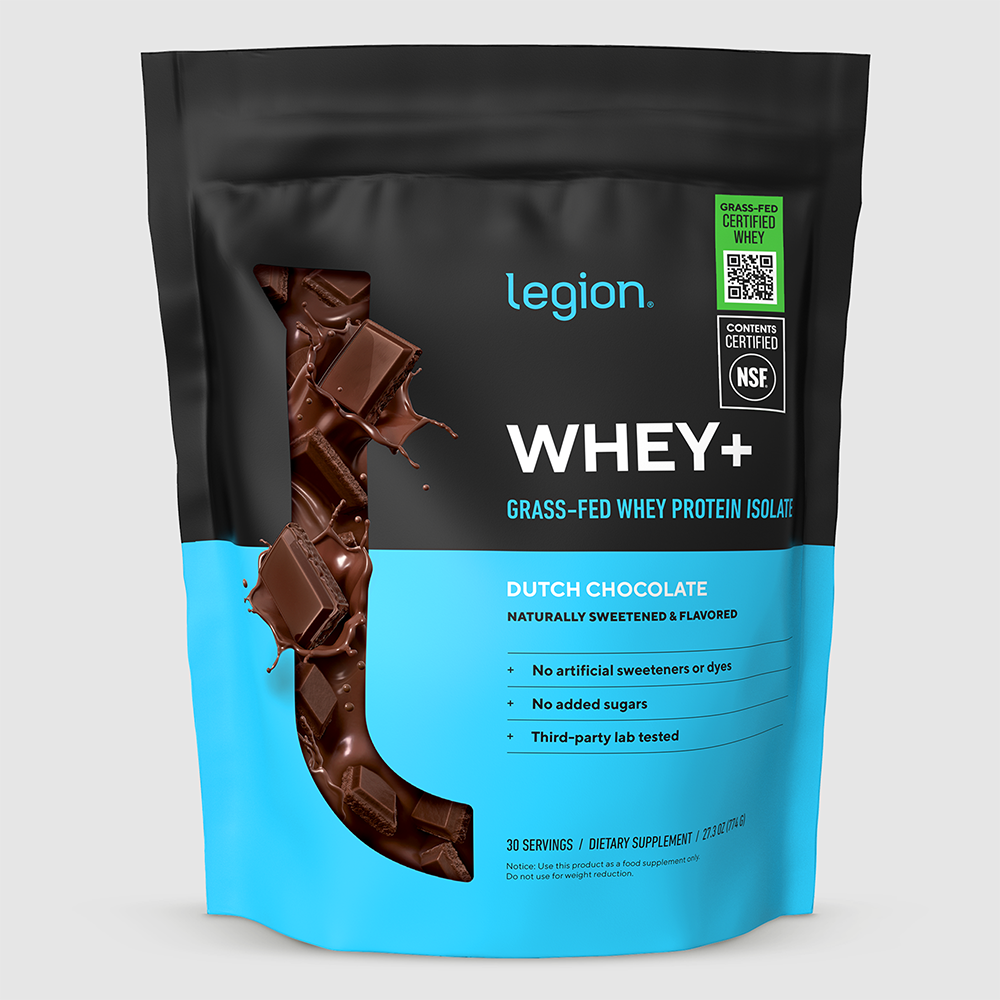
9.4/10 safety
COALegion
Whey+ Whey Protein Powder
Varies · 1 scoop serving
Best for · #5 lowest heavy metals of 34 rated
Lead: too small to measure
22.5 g protein per scoop · Complete protein
$54.99 · updated 22 Nov
Lab details & evidence ▾
Heavy metals
µg/serving · independent test, not scored. ND = not detected; below LOQ = too small to measure; iAs = inorganic arsenic.
Metals score 9.4/10 · measured against Prop 65 (California's daily safe limit)
Brand-published test: Legion COA, lot 2623152: Cd 0.01 ppm × 26 g; Pb/As (<0.01 ppm) and Hg (<0.001 ppm) below LOQ (counted as 0).
Protein quality
Complete
- Limiting amino acid:
- None (histidine is the closest to the reference level)
- Metric:
- DIAAS 1.09 · PDCAAS 1.00 (DIAAS/PDCAAS are lab scores for protein quality; 1.0 is the top)
- Rich in:
- Leucine 2.41 g, lysine 2.34 g, threonine 1.56 g per serving; 5.6 g BCAAs, 12 g EAAs (brand data)
- Low in:
- None below reference; histidine is the lowest relative to need
Source: Brand data (amino-acid profile on product page) · score basis: Typical for whey protein isolate (published studies: DIAAS 1.09, PDCAAS 1.00, Rutherfurd et al. 2015)
- Protein:
- Whey isolate (grass-fed)
- Completeness:
- Complete — Whey isolate; complete (PDCAAS 1.0).
- Completeness score:
- 10.0/10 — typical value for whey protein isolate (DIAAS 1.09, Rutherfurd et al. 2015, J Nutr 145:372)
Sources
- Independent test (not scored):
- Labdoor / third-party lab COA (ICP-MS) · checked 2026-03-06
- Evidence:
- Labdoor review 6 Mar 2026: 22.5 g protein measured vs 22 g claimed; lead, cadmium, arsenic and mercury all below limit of quantification. Not quantified ≠ zero; methods differ from CR.
- Price:
- ≈ $1.90/serving · 11.8 g protein per $ (approx., verify at checkout)
Related articles
Protein powder without heavy metals: what “zero metals” actually means
2026-11-15
No lab can prove a scoop is metaphysically metal-free. ND and below-LOQ results still beat vague “clean” claims — here are the powders that publish the tightest brand panels against Prop 65 MADLs.
Clean Label Project certified protein powder: Purity Award vs Transparency COAs
2026-11-15
CLP’s Purity Award means a product landed in the top third of its category on contaminant testing — not a fixed 0.5 µg lead pass. Here’s how that differs from lot COAs, NSF seals, and our metals scores.
Prop 65 warning on protein powder: what Amazon listings mean
2026-11-13
A California Prop 65 warning on an Amazon protein-powder listing is a right-to-know notice about listed chemicals (often lead or cadmium) — not an FDA recall, not a metals COA, and not proof the tub is “safe” or “banned.”
As an Amazon Associate I earn from qualifying purchases. Affiliate status never changes rank. 0 paid placements.