
Science commentary · 2026-10-30 · Updated 2026-11-14
Soy protein powder: hormones, completeness and heavy metals
Soy isolate is a complete plant protein, reaching the capped PDCAAS score of 1.0 [1][2]. Reed's meta-analysis of 41 clinical studies found no significant effect on male reproductive hormones [3], while newer dose-response work adds caution at higher isoflavone doses [4]. We do not list a soy-isolate powder with brand-published heavy-metal COAs: that is a data gap, not proof of low metals. This is general nutrition information, not medical advice.


The short answer
Soy isolate is a complete plant protein, reaching the capped PDCAAS score of 1.0 [1][2]. Reed's meta-analysis of 41 clinical studies found no significant effect on male reproductive hormones [3], while newer dose-response work adds caution at higher isoflavone doses [4]. We do not list a soy-isolate powder with brand-published heavy-metal COAs: that is a data gap, not proof of low metals. This is general nutrition information, not medical advice.
Our lab-verified picks
5.5/10 safety
ICP-MSRitual
Essential Protein Daily Shake
Chocolate · 33 g serving
Best for · #9 lowest heavy metals of 34 rated
Lead: 0.53 µg per scoop — above the daily safe limit
20 g protein per scoop · Not quite complete (a bit low in methionine + cysteine)
$50.00 · updated 22 Nov
Lab details & evidence ▾
Heavy metals
µg/serving · independent test, not scored. ND = not detected; below LOQ = too small to measure; iAs = inorganic arsenic.
Metals score 5.5/10 · measured against Prop 65 (California's daily safe limit)
Brand-published test: Ritual Certificate of Traceability, lot 521594405 (released 2 Oct 2025): Cd 0.06 ppm × 31 g; Pb <0.02 ppm, As <0.015 ppm and Hg <0.01 ppm (below LOQ, counted as 0).
Protein quality
Complete per brand (methionine-fortified pea); DIAAS shown is typical for unfortified pea protein
- Limiting amino acid:
- Methionine + cysteine (typical for pea protein)
- Metric:
- DIAAS 0.82 · PDCAAS 0.89 (DIAAS/PDCAAS are lab scores for protein quality; 1.0 is the top)
- Rich in:
- Leucine 1.79 g, lysine 1.60 g per serving; +400 mg added L-methionine; 8 g EAAs, 4 g BCAAs (brand data)
- Low in:
- Methionine is pea's usual gap — Ritual adds 400 mg L-methionine (brand data); cysteine not published
Source: Brand data (label amino-acid profile) + score uses typical pea protein value (published studies) · score basis: Typical for pea protein (published studies: DIAAS 0.82, PDCAAS 0.89, Rutherfurd et al. 2015)
- Protein:
- Pea protein
- Completeness:
- Depends on formula — Single-source pea protein with 400 mg added L-methionine, which Ritual says provides a complete amino acid profile; no public PDCAAS/DIAAS.
- Completeness score:
- 8.2/10 — typical value for pea protein concentrate (DIAAS 0.82, Rutherfurd et al. 2015, J Nutr 145:372)
Sources
- Independent test (not scored):
- Consumer Reports ICP-MS (AOAC 2015.01) · checked 2026-01-08
- Evidence:
- CR Jan 2026 follow-up; lots purchased Nov 2025; chocolate only; averages of 2-3 lots; µg per labeled serving. Inorganic arsenic NT (total As below CR concern). Source: CR methodology PDF. CR says up to about 6.5 servings/week. Buy-link note (2026-11-07): no confirmed Amazon ASIN for the CR-tested Chocolate flavor (Vanilla ASINs B0FSFYZP6F / B09W36RMCX resolve to Vanilla B0DQ68JDSC); card uses Ritual DTC https://ritual.com/products/essential-protein-daily-shake-18-chocolate (HTTP 200). Note (2026-10-19): Ritual's product page lists a Clean Label Project Purity Award and NSF Contents Certified, and shows a California Prop 65 lead warning. COA note (2026-10-20): Ritual's on-page Certificate of Traceability for Chocolate (lot 521594405, quality release 2 Oct 2025) lists cadmium 0.06 ppm, lead <0.02 ppm, arsenic <0.015 ppm and mercury <0.01 ppm. At the label's ~31 g serving that is about 1.9 µg cadmium, in line with CR's 1.944 µg. Single-lot brand COA; CR figures are used for ranking. Protein grams (2026-10-27): 20 g per serving per Ritual's Chocolate supplement facts (ritual.com/products/essential-protein-daily-shake-18-chocolate).
3.6/10 safety
ICP-MSTruvani
Plant-Based Protein
Chocolate · 33 g serving
Best for · #10 lowest heavy metals of 34 rated
Lead: 0.46 µg per scoop — under the daily safe limit
20 g protein per scoop · Not quite complete (a bit low in methionine + cysteine)
See price
Lab details & evidence ▾
Heavy metals
µg/serving · independent test, not scored. ND = not detected; below LOQ = too small to measure; iAs = inorganic arsenic.
Metals score 3.6/10 · measured against Prop 65 (California's daily safe limit)
Brand-published test: Truvani test-results page: lead only (0.319 µg/serving); brand publishes no Cd/As figure for this product, so only lead is scored.
Protein quality
Incomplete by DIAAS (typical for pea protein)
- Limiting amino acid:
- Methionine + cysteine (typical for pea protein)
- Metric:
- DIAAS 0.82 · PDCAAS 0.89 (DIAAS/PDCAAS are lab scores for protein quality; 1.0 is the top)
- Rich in:
- Not published (Brand doesn't publish amino-acid data)
- Low in:
- Methionine + cysteine (typical for pea protein)
Source: Brand doesn't publish amino-acid data (brand FAQ says only 'complete amino acid profile') — values typical for pea protein (published studies) · score basis: Typical for pea protein (published studies: DIAAS 0.82, PDCAAS 0.89, Rutherfurd et al. 2015)
- Protein:
- Plant blend (pea, pumpkin seed, chia seed)
- Completeness:
- Depends on formula — Pea-led blend with smaller amounts of pumpkin seed and chia seed protein (per Truvani's ingredient list); no public PDCAAS/DIAAS, so completeness depends on formula.
- Completeness score:
- 8.2/10 — typical value for pea protein concentrate (DIAAS 0.82, Rutherfurd et al. 2015, J Nutr 145:372)
Sources
- Independent test (not scored):
- Consumer Reports ICP-MS (AOAC 2015.01) · checked 2026-01-08
- Evidence:
- CR Jan 2026 follow-up; lots purchased Nov 2025; chocolate only; averages of 2-3 lots; µg per labeled serving. Inorganic arsenic NT (total As below CR concern). Source: CR methodology PDF. CR's Jan 2026 best-picks list: up to 1 serving/day. Protein source corrected (2026-10-19): Truvani's Chocolate ingredient list (Amazon B0DDQHJ2NG, sold by Truvani) is organic pea protein, organic pumpkin seed and organic chia seed protein, not pea alone. Protein grams (2026-10-27): 20 g per 33 g scoop per Truvani's FAQ (faq.truvani.com) and the Chocolate nutrition panel.
0.0/10 safety
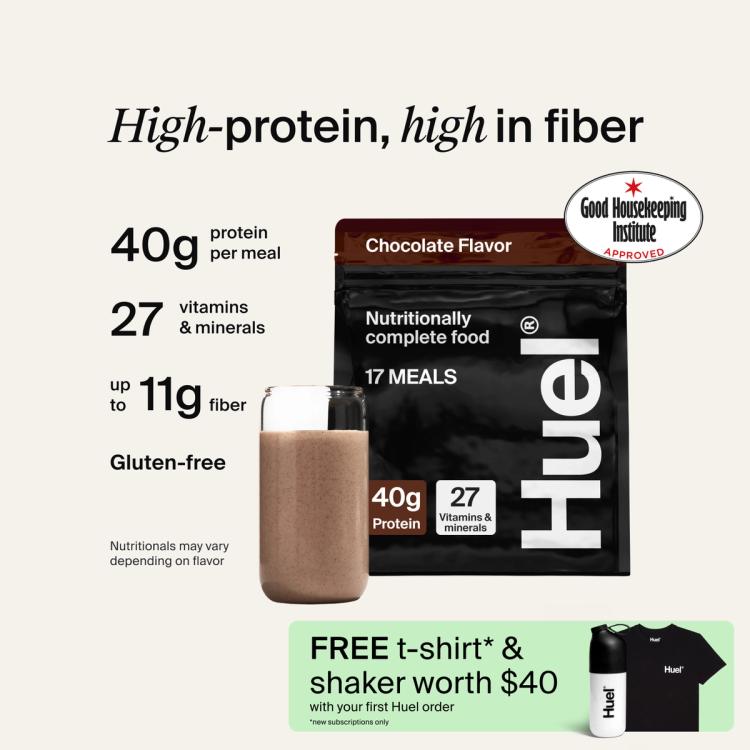
ICP-MSHuel
Black Edition
Chocolate · 90 g serving
Best for · #12 lowest heavy metals of 34 rated
Lead: 6.31 µg per scoop — above the daily safe limit
Cadmium above the daily safe limit
40 g protein per scoop · Complete protein
$45.00 · updated 22 Nov
$1.99 / 30 g protein
Lab details & evidence ▾
Heavy metals
µg/serving · independent test, not scored. ND = not detected; below LOQ = too small to measure; iAs = inorganic arsenic.
Metals score 0.0/10 · measured against Prop 65 (California's daily safe limit)
Brand-published test: Huel states 1.5–2.2 µg lead per serving for Black Edition; the lowest figure (1.5 µg) already exceeds the Prop 65 lead MADL.
Protein quality
Incomplete by DIAAS (typical for pea protein)
- Limiting amino acid:
- Methionine + cysteine (typical for pea protein)
- Metric:
- DIAAS 0.82 · PDCAAS 0.89 (DIAAS/PDCAAS are lab scores for protein quality; 1.0 is the top)
- Rich in:
- Leucine 3.06 g, lysine 2.42 g per 90 g serving (brand data, EU formula)
- Low in:
- Methionine 0.53 g per serving (cysteine not published) — pea's usual gap, partly offset by brown rice
Source: Brand data (EAA profile posted by Huel staff, EU formula) + score uses typical pea protein value · score basis: Typical for pea protein (published studies: DIAAS 0.82, PDCAAS 0.89, Rutherfurd et al. 2015)
- Protein:
- Plant blend (pea, brown rice) meal powder
- Completeness:
- Complete (blend) — Pea + brown rice blend intended as a complete meal; no public DIAAS for this formula.
- Completeness score:
- 8.2/10 — typical value for pea protein concentrate (DIAAS 0.82, Rutherfurd et al. 2015, J Nutr 145:372)
Sources
- Independent test (not scored):
- Consumer Reports ICP-MS (AOAC 2015.01) · checked 2025-10-14
- Evidence:
- Average of lots purchased Nov 2024–Jan 2025; µg per labeled serving. Highest lead and cadmium in the CR set; Consumer Reports advised against use.
- Price:
- ≈ $3.00/serving · 13.3 g protein per $ (approx., verify at checkout)
Why the "soy feminises men" question sticks
Isoflavones are phytoestrogens. Gym folklore turned that chemistry into a stopwatch rule about low testosterone. What the clinical literature actually shows is quieter: pooled human data do not support a reliable drop in free testosterone from ordinary soy or isoflavone intakes [3]. The open questions are dose, duration, and which hormone markers move — not a cartoon "manboobs from tofu" story.
Separately, shoppers who avoid dairy for ethics or digestion often land on pea or rice before soy. Pea and rice have their own metals and amino-acid trade-offs — see pea vs rice protein and why plant proteins test higher for lead. Completeness scoring is covered in PDCAAS, DIAAS and amino acids.
What Reed 2021 actually pooled
Reed, Camargo, Hamilton-Reeves, Kurzer and Messina meta-analysed clinical studies of soy foods, soy protein or isoflavone extracts in adult men [3]:
| Outcome | Men with data | Result across models |
|---|---|---|
| Total testosterone (TT) | 1,753 | No significant effect |
| Free testosterone (FT) | 752 | No significant effect |
| Estradiol (E2) | 1,000 | No significant effect |
| Estrone (E1) | 239 | No significant effect |
| SHBG | 967 | No significant effect |
Sub-analyses by isoflavone dose and study duration also showed no effect [3]. That is the paper behind "soy does not lower testosterone" headlines. It does not prove every soy product is inert for every person; it says the pooled clinical signal for those hormones is null.
What the newer Food Frontiers dose–response analysis adds
Rajaie et al. (Food Frontiers, searched to September 2024) ran a dose–response meta-analysis of RCTs of soy/isoflavones and male reproductive hormones [4]:
- Testosterone: no significant overall effect (WMD about 12 pg/mL; 95% CI crossed zero); no clear linear or nonlinear dose–response for testosterone in their models.
- Estradiol and SHBG: overall mean differences versus control were not significant in the main pooled estimates, but a nonlinear dose–response suggested estradiol rising by roughly 6.5 pg/mL near ~72 mg/day isoflavones and SHBG rising near ~120 mg/day — with the authors stressing the limited number of studies.
Read that as a caution about high-dose isoflavone supplements and sparse data, not as proof that a scoop of soy isolate "raises oestrogen." Typical soy protein isolate servings deliver far less isoflavone than many concentrated extracts; always check the label if that matters to you.
The 18-month post-prostatectomy soy-isolate RCT
Bosland et al. randomised middle-aged and older men after radical prostatectomy to 19.2 g/day soy protein isolate (about 24 mg genistein) or a casein placebo for 18 months [5]:
- Lower circulating total testosterone and SHBG on soy versus casein.
- No change in free testosterone or estradiol.
- Other cancer-related biomarkers in that panel were largely unchanged.
This is a specific clinical population (post-prostatectomy), not a gym RCT in healthy young men. It shows the androgen axis can move on long-term isolate intake without a free-T or estradiol shift in that design [5]. It does not overturn Reed's null pooled result for free testosterone.
Completeness: soy vs pea vs whey
| Protein | Completeness story | What we use on this site |
|---|---|---|
| Whey isolate | Complete; high DIAAS in Rutherfurd et al. 2015 | Typical DIAAS ~1.09 → completeness 10.0 [6] |
| Soy protein isolate | PDCAAS reaches the 1.0 cap (same ceiling as whey/egg) [1][2] | We have no soy SKU to score today |
| Pea protein concentrate | Often limited by methionine + cysteine | Typical DIAAS 0.82 → completeness 8.2 [6] |
FAO's 2013 expert consultation set the DIAAS framework and discussed why truncating PDCAAS can hide differences between high-quality proteins such as milk and soy [1]. Schaafsma's Journal of Nutrition review lists untruncated FAO/WHO-era figures including soy at 91 versus egg 118 and milk 121 — before the 1.0 cap flattens them [2].
Practical takeaway: soy isolate is a complete plant protein on the classic PDCAAS ceiling; pea usually needs a blend or methionine fortification to chase the same label story.
Heavy metals: the soy data gap on our board
We score only brand-published µg-per-serving metals against Prop 65 daily figures (lead 0.5 µg, cadmium 4.1 µg, inorganic arsenic 10 µg) [7]. Independent CR/Labdoor figures appear on cards but are unscored (how we score; limitations).
None of our current ranked products is a soy protein powder. The plant options on the board are pea-led or pea+rice/seed blends (for example Ritual Essential Protein Chocolate, Truvani Plant-Based Protein Chocolate, Orgain Organic Protein, Huel Black Edition). So we cannot honestly place "soy isolate" on a metals ladder from our dataset.
What we can say from adjacent plant data:
| Product (not soy) | Why it appears in plant conversations | Brand metals score |
|---|---|---|
| Ritual Essential Protein Chocolate | Pea + added methionine; highest-ranked available plant with brand metals | 5.5 |
| Truvani Chocolate | Pea/pumpkin/chia; brand publishes lead only | 3.6 |
| Puori PW1 / Legion Whey+ | Dairy comparison points when soy is optional | 10.0 / 9.4 |
If you specifically want soy for completeness or preference, ask the brand for a recent ICP-MS COA in µg per labeled serving covering Pb, Cd, As and Hg — the same standard we apply to every scored product (how to read a COA). Plant powders as a class still tend to test higher for lead than whey in public lab tables see mechanism. Whey-price pressure is not a reason to skip that check — see whey shortage and switching to plant.
Practical steps
- Hormones: treat Reed 2021 as the best pooled evidence for no free-T drop; treat Rajaie 2025 as a sparse-data caution at higher isoflavone doses; treat Bosland 2021 as a long-duration isolate signal in a post-prostatectomy cohort [3][4][5].
- Completeness: soy isolate is a legitimate complete plant option on PDCAAS; pea/rice blends are a different amino-acid story [1][2][6].
- Metals: until a soy powder publishes usable COAs we can score, prefer dairy low-metal picks or the plant products we already list on rankings and best vegan protein.
- Digestion: soy is still a legume protein; if shakes bloat you, formula and dose matter — see protein powder bloating fixes.
For men’s shopping that pairs listicle names with metals scores (including the soy–testosterone question), see best protein powder for men. Browse more guides in the journal. As an Amazon Associate I earn from qualifying purchases.
Bottom line
Soy protein is not a testosterone killer in the pooled clinical data, and it is one of the strongest plant completeness stories on PDCAAS. Dose-response work and one long isolate RCT add nuance without rewriting that headline. Our metals ranking simply does not yet include a soy powder — demand brand COAs before you treat any tub as "clean."
FAQ
Does soy protein lower testosterone in men?
Reed et al. found no significant effect on total or free testosterone across 41 clinical studies [3]. Rajaie et al. also found no overall testosterone effect in their RCT meta-analysis [4].
Does soy raise oestrogen in men?
Reed found no significant effect on estradiol or estrone [3]. Rajaie reported a nonlinear estradiol/SHBG dose–response at higher isoflavone intakes based on few studies [4].
Is soy a complete protein?
Soy protein isolate reaches a PDCAAS of 1.0 (capped), matching whey and egg on that ceiling [1][2]. Product-specific DIAAS for retail soy powders is rarely published.
Is soy lower in lead than pea protein?
We cannot say from our board — we have no scored soy powder. Compare any candidate against rankings once brand µg/serving data exist. Plant powders as a group often test higher than whey why.
Should I pick soy over pea for daily use?
Completeness favours soy isolate on classic PDCAAS. Metals favour whichever product publishes the better recent COA. Pea-led options we already score: Ritual and Truvani on rankings.
Is this medical advice?
No. Hormone disorders, prostate disease and supplement use in clinical populations need a clinician. The studies above are evidence summaries, not personal recommendations.
References
- FAO. Dietary protein quality evaluation in human nutrition: Report of an FAO Expert Consultation. FAO Food and Nutrition Paper 92 (2013)
- Schaafsma G. The protein digestibility-corrected amino acid score. J Nutr 2000;130:1865S-1867S
- Reed KE et al. Neither soy nor isoflavone intake affects male reproductive hormones: An expanded and updated meta-analysis of clinical studies. Reprod Toxicol 2021;100:60-67
- Rajaie SH et al. The impact of soy products and isoflavones on male reproductive hormones: a systematic review and dose–response meta-analysis of randomized controlled trials. Food Frontiers 2025
- Bosland MC et al. Impact of 18-month soy protein supplementation on steroid hormones and serum biomarkers… randomised trial in males following prostatectomy. Nutr Cancer 2022;74:110-121
- Rutherfurd SM et al. PDCAAS and DIAAS differentially describe protein quality in growing male rats. J Nutr 2015;145:372-9
- OEHHA. Current Proposition 65 No Significant Risk Levels (NSRLs) and Maximum Allowable Dose Levels (MADLs)
Related articles
Complete protein vs heavy metals: how to pick a powder with full amino acids and low lead (2026)
2026-10-09
A good protein powder has to do two jobs: supply all nine essential amino acids and keep lead and cadmium low. Here's how completeness works, why plant powders are blended, and how the lab data lines up.
Pea vs rice protein: lead, arsenic and amino acids compared
2026-10-27
Pea tends to bring more lead and cadmium plus lysine; rice protein raises inorganic arsenic risk and is low in lysine. Why blends exist, and which low-metal picks we list.
Egg white protein powder: complete protein, but how clean? Heavy-metal data (2026)
2026-10-22
Egg white is one of the highest-quality proteins there is, and the few published heavy-metal results look low. But no Consumer Reports or quantified Labdoor data exists for egg white powders yet, and a 'pass' or 'not detected' can still hide more than 0.5 µg of lead per scoop. Here's what the data shows.
As an Amazon Associate I earn from qualifying purchases. Affiliate status never changes rank. 0 paid placements.