
Research · 2026-10-25 · Updated 2026-11-13
Huel Black Edition and heavy metals: what the lab tests found
Consumer Reports found 6.3 µg lead and 9.2 µg cadmium per serving of Huel Black Edition; Huel says 1.5–2.2 µg lead. We compare both data sets, the NSF report and what it means per meal.


The short answer
Consumer Reports' 2025 tests found 6.3 µg of lead and 9.2 µg of cadmium in one 90 g serving of Huel Black Edition, and CR advised against using it [1]. Huel's own figures are lower: 1.5–2.2 µg of lead per serving across 17 tests [2][3]. Even that lowest figure is three times California's Prop 65 level of 0.5 µg a day, so Black Edition scores 0 for metals in our rankings. This is general wellness information, not medical advice.
Our lab-verified picks

9.4/10 safety
ICP-MSClean Simple Eats
Protein Powder
Chocolate Brownie Batter · 34 g serving
Best for · #4 lowest heavy metals of 34 rated
Lead: 0.2 µg per scoop — well under the daily safe limit
20 g protein per scoop · Complete protein
$64.99 · updated 22 Nov
$3.25 / 30 g protein
Lab details & evidence ▾
Heavy metals
µg/serving · independent test, not scored. ND = not detected; below LOQ = too small to measure; iAs = inorganic arsenic.
Metals score 9.4/10 · measured against Prop 65 (California's daily safe limit)
Brand-published test: Clean Simple Eats COA, lot BBFE192028RY (Chocolate Brownie Batter, 27 g serving): Pb 0.028, Cd 0.165, Hg 0.014 µg/serving; As <0.001 (counted as 0).
Protein quality
Complete
- Limiting amino acid:
- None (histidine is the closest to the reference level)
- Metric:
- DIAAS 1.09 · PDCAAS 1.00 (DIAAS/PDCAAS are lab scores for protein quality; 1.0 is the top)
- Rich in:
- Leucine and BCAAs (typical for whey; Brand doesn't publish amino-acid data)
- Low in:
- None below reference; histidine is the lowest relative to need
Source: Brand doesn't publish amino-acid data — values typical for whey isolate (published studies) · score basis: Typical for whey protein isolate (published studies: DIAAS 1.09, PDCAAS 1.00, Rutherfurd et al. 2015)
- Protein:
- Dairy/whey protein
- Completeness:
- Complete — Dairy/whey protein; complete amino acid profile.
- Completeness score:
- 10.0/10 — typical value for whey protein isolate (DIAAS 1.09, Rutherfurd et al. 2015, J Nutr 145:372)
Sources
- Independent test (not scored):
- Consumer Reports ICP-MS (AOAC 2015.01) · checked 2026-01-08
- Evidence:
- CR Jan 2026 follow-up; lots purchased Nov 2025; chocolate only; averages of 2-3 lots; µg per labeled serving. Inorganic arsenic NT (total As below CR concern). Source: CR methodology PDF. CR better for daily use (0.205 µg lead ≈ 42% of the 0.5 µg concern level). CR's Jan 2026 best-picks list: up to 2⅓ servings/day. Protein grams (2026-10-27): 20 g per serving per the Amazon listing B0912XJ8H4 (Chocolate Brownie Batter).
9.4/10 safety
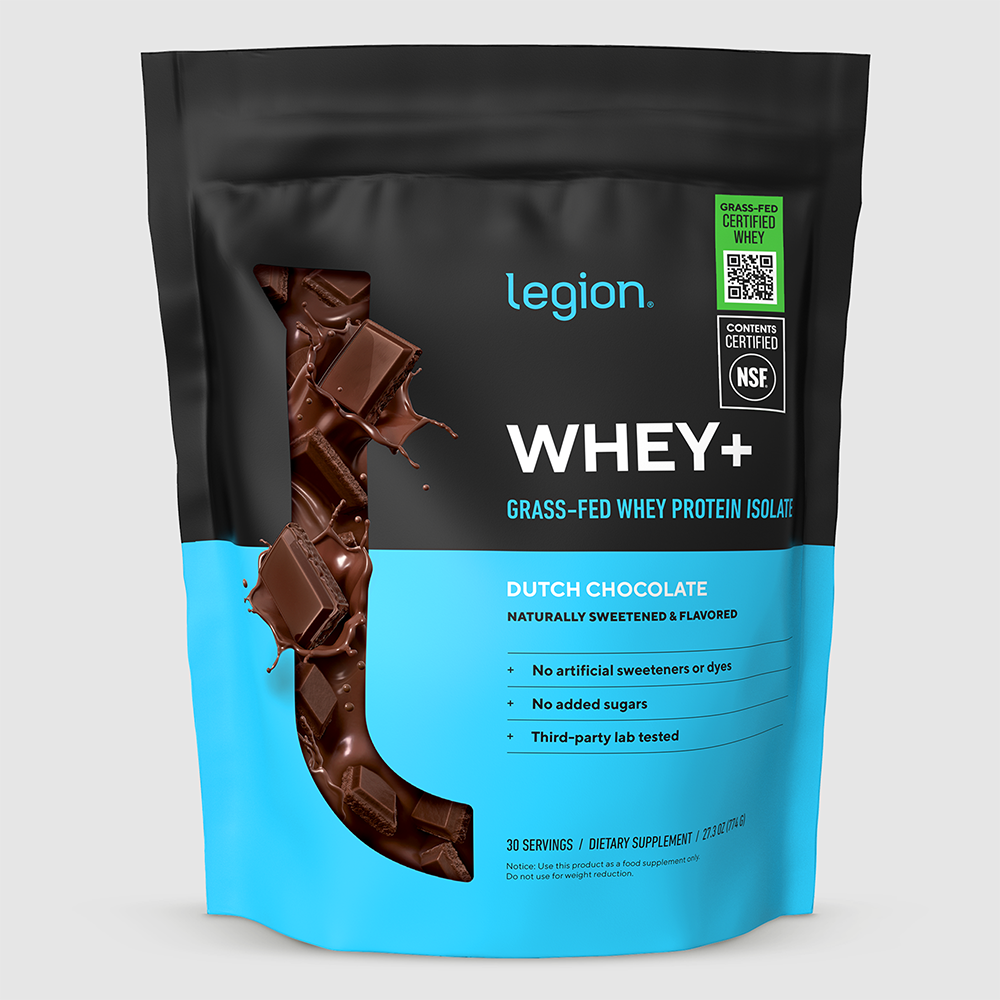
COALegion
Whey+ Whey Protein Powder
Varies · 1 scoop serving
Best for · #5 lowest heavy metals of 34 rated
Lead: too small to measure
22.5 g protein per scoop · Complete protein
$54.99 · updated 22 Nov
Lab details & evidence ▾
Heavy metals
µg/serving · independent test, not scored. ND = not detected; below LOQ = too small to measure; iAs = inorganic arsenic.
Metals score 9.4/10 · measured against Prop 65 (California's daily safe limit)
Brand-published test: Legion COA, lot 2623152: Cd 0.01 ppm × 26 g; Pb/As (<0.01 ppm) and Hg (<0.001 ppm) below LOQ (counted as 0).
Protein quality
Complete
- Limiting amino acid:
- None (histidine is the closest to the reference level)
- Metric:
- DIAAS 1.09 · PDCAAS 1.00 (DIAAS/PDCAAS are lab scores for protein quality; 1.0 is the top)
- Rich in:
- Leucine 2.41 g, lysine 2.34 g, threonine 1.56 g per serving; 5.6 g BCAAs, 12 g EAAs (brand data)
- Low in:
- None below reference; histidine is the lowest relative to need
Source: Brand data (amino-acid profile on product page) · score basis: Typical for whey protein isolate (published studies: DIAAS 1.09, PDCAAS 1.00, Rutherfurd et al. 2015)
- Protein:
- Whey isolate (grass-fed)
- Completeness:
- Complete — Whey isolate; complete (PDCAAS 1.0).
- Completeness score:
- 10.0/10 — typical value for whey protein isolate (DIAAS 1.09, Rutherfurd et al. 2015, J Nutr 145:372)
Sources
- Independent test (not scored):
- Labdoor / third-party lab COA (ICP-MS) · checked 2026-03-06
- Evidence:
- Labdoor review 6 Mar 2026: 22.5 g protein measured vs 22 g claimed; lead, cadmium, arsenic and mercury all below limit of quantification. Not quantified ≠ zero; methods differ from CR.
- Price:
- ≈ $1.90/serving · 11.8 g protein per $ (approx., verify at checkout)

6.6/10 safety
COATransparent Labs
100% Grass-Fed Whey Protein Isolate
Varies · 1 scoop serving
Best for · #8 lowest heavy metals of 34 rated
Lead: 0.16 µg per scoop — well under the daily safe limit
28.12 g protein per scoop · Complete protein
$64.99 · updated 22 Nov
Lab details & evidence ▾
Heavy metals
µg/serving · independent test, not scored. ND = not detected; below LOQ = too small to measure; iAs = inorganic arsenic.
Metals score 6.6/10 · measured against Prop 65 (California's daily safe limit)
Protein quality
Complete
- Limiting amino acid:
- None (histidine is the closest to the reference level)
- Metric:
- DIAAS 1.09 · PDCAAS 1.00 (DIAAS/PDCAAS are lab scores for protein quality; 1.0 is the top)
- Rich in:
- Leucine and BCAAs (typical for whey isolate; Brand doesn't publish amino-acid data on its product page)
- Low in:
- None below reference; histidine is the lowest relative to need
Source: Brand doesn't publish amino-acid data — values typical for whey isolate (published studies) · score basis: Typical for whey protein isolate (published studies: DIAAS 1.09, PDCAAS 1.00, Rutherfurd et al. 2015)
- Protein:
- Whey isolate (grass-fed)
- Completeness:
- Complete — Whey isolate; complete (PDCAAS 1.0).
- Completeness score:
- 10.0/10 — typical value for whey protein isolate (DIAAS 1.09, Rutherfurd et al. 2015, J Nutr 145:372)
Sources
- Independent test (not scored):
- Labdoor / third-party lab COA (ICP-MS) · checked 2026-08-07
- Evidence:
- Labdoor review 7 Aug 2026: 28.12 g protein measured; Pb 0.16, As 0.1, Cd 0.35 µg/serving, Hg below LOQ. Newest brand COA (2026-10-29 check): French Vanilla lot 26080570 (Advanced Laboratories, 27 Aug 2026): Pb 0.17, Cd 0.07, As 0.31 µg, Hg <0.03 µg per 34.3 g. Vanilla lot 26071523 (reported 10 Aug 2026): Pb, Cd, Hg <0.001, As 0.118 µg per 34.3 g.
- Price:
- ≈ $2.00/serving · 14.1 g protein per $ (approx., verify at checkout)

5.5/10 safety
ICP-MSRitual
Essential Protein Daily Shake
Chocolate · 33 g serving
Best for · #9 lowest heavy metals of 34 rated
Lead: 0.53 µg per scoop — above the daily safe limit
20 g protein per scoop · Not quite complete (a bit low in methionine + cysteine)
$50.00 · updated 22 Nov
Lab details & evidence ▾
Heavy metals
µg/serving · independent test, not scored. ND = not detected; below LOQ = too small to measure; iAs = inorganic arsenic.
Metals score 5.5/10 · measured against Prop 65 (California's daily safe limit)
Brand-published test: Ritual Certificate of Traceability, lot 521594405 (released 2 Oct 2025): Cd 0.06 ppm × 31 g; Pb <0.02 ppm, As <0.015 ppm and Hg <0.01 ppm (below LOQ, counted as 0).
Protein quality
Complete per brand (methionine-fortified pea); DIAAS shown is typical for unfortified pea protein
- Limiting amino acid:
- Methionine + cysteine (typical for pea protein)
- Metric:
- DIAAS 0.82 · PDCAAS 0.89 (DIAAS/PDCAAS are lab scores for protein quality; 1.0 is the top)
- Rich in:
- Leucine 1.79 g, lysine 1.60 g per serving; +400 mg added L-methionine; 8 g EAAs, 4 g BCAAs (brand data)
- Low in:
- Methionine is pea's usual gap — Ritual adds 400 mg L-methionine (brand data); cysteine not published
Source: Brand data (label amino-acid profile) + score uses typical pea protein value (published studies) · score basis: Typical for pea protein (published studies: DIAAS 0.82, PDCAAS 0.89, Rutherfurd et al. 2015)
- Protein:
- Pea protein
- Completeness:
- Depends on formula — Single-source pea protein with 400 mg added L-methionine, which Ritual says provides a complete amino acid profile; no public PDCAAS/DIAAS.
- Completeness score:
- 8.2/10 — typical value for pea protein concentrate (DIAAS 0.82, Rutherfurd et al. 2015, J Nutr 145:372)
Sources
- Independent test (not scored):
- Consumer Reports ICP-MS (AOAC 2015.01) · checked 2026-01-08
- Evidence:
- CR Jan 2026 follow-up; lots purchased Nov 2025; chocolate only; averages of 2-3 lots; µg per labeled serving. Inorganic arsenic NT (total As below CR concern). Source: CR methodology PDF. CR says up to about 6.5 servings/week. Buy-link note (2026-11-07): no confirmed Amazon ASIN for the CR-tested Chocolate flavor (Vanilla ASINs B0FSFYZP6F / B09W36RMCX resolve to Vanilla B0DQ68JDSC); card uses Ritual DTC https://ritual.com/products/essential-protein-daily-shake-18-chocolate (HTTP 200). Note (2026-10-19): Ritual's product page lists a Clean Label Project Purity Award and NSF Contents Certified, and shows a California Prop 65 lead warning. COA note (2026-10-20): Ritual's on-page Certificate of Traceability for Chocolate (lot 521594405, quality release 2 Oct 2025) lists cadmium 0.06 ppm, lead <0.02 ppm, arsenic <0.015 ppm and mercury <0.01 ppm. At the label's ~31 g serving that is about 1.9 µg cadmium, in line with CR's 1.944 µg. Single-lot brand COA; CR figures are used for ranking. Protein grams (2026-10-27): 20 g per serving per Ritual's Chocolate supplement facts (ritual.com/products/essential-protein-daily-shake-18-chocolate).
Both data sets in detail
Consumer Reports' 2025 tests found an average of 6.3 µg of lead and 9.2 µg of cadmium in one 90 g serving of Huel Black Edition. That was the second-highest lead and the highest cadmium result among the protein products it tested, and CR advised against using it [1]. Huel's own figures are much lower: 1.5–2.2 µg of lead per serving across 17 tests, and cadmium of about 1.5 µg. A March 2025 NSF lab report for one lot found 1.5 µg cadmium and lead below the test's 3.6 µg limit of quantitation [2][3][4].
Even Huel's lowest published lead figure is three times California's Prop 65 level of 0.5 µg a day. So Black Edition gets 0 for metals in our rankings and 3.3 overall (see its card). Measured per gram of protein, and against the meal it replaces, the picture is less extreme but still not in the low-lead group.
What Huel Black Edition is
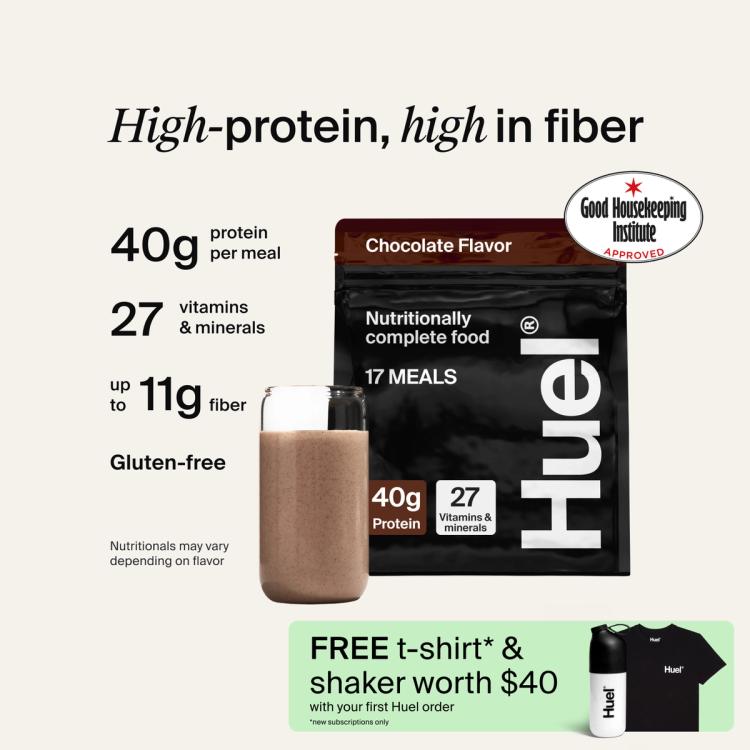
Huel Black Edition is a powdered meal replacement, not a pure protein powder. A 90 g serving provides 400 kcal and 40 g of protein. For the Chocolate flavour it also provides 17 g fat, 24 g carbohydrate and 8 g fibre [5]. The protein comes mainly from pea and brown rice, with flaxseed, tapioca and, in chocolate, cocoa.
That matters for heavy metals in two ways:
- The serving is large. At 90 g, a serving is three to four times the mass of a typical whey scoop. Even a modest concentration per gram adds up to a larger amount per serving.
- The ingredients are the ones that tend to carry metals. Pea and rice proteins take up lead and cadmium from soil, and cocoa is a well-known source of cadmium. Our explainers on why plant proteins test higher for lead and whether chocolate protein is dirtier cover the mechanisms.
Huel is widely recommended. For example, a major health publisher still lists it as its best meal-replacement protein shake. That is why the gap between the independent and brand data deserves a careful look.
What Consumer Reports found
Consumer Reports published its protein testing in October 2025 and updated it in January 2026. It bought two to four lots of each product over about three months starting in November 2024 and reported averages per serving [1]. For Huel Black Edition (90 g serving, 40 g protein), CR reported:
- Lead: 6.3 µg per serving, more than 12 times CR's 0.5 µg daily level of concern
- Cadmium: 9.2 µg per serving, more than double the 4.1 µg level
- Total arsenic: 1.42 µg, and mercury 0.08 µg, from CR's published figures
Of the products CR tested, only Naked Nutrition's vegan mass gainer, at 7.7 µg per much larger 315 g serving, had more lead (its card). CR noted that plant-based products averaged about nine times the lead of dairy-based ones [1]. Our summary of the CR results puts Huel's numbers in context with the full product set.
CR reported that Huel did not answer its questions about cadmium. A Huel spokesperson said its levels were "well within the levels set out by NSF" [1].
What Huel says
Huel responded publicly in October 2025, on its heavy-metals page and its community forum.
- Lead: Huel says Black Edition contains 1.5–2.2 µg of lead per 90 g serving across 17 tests in about three years, with an average of 1.8 µg [2][3].
- Cadmium: a Huel staff member said cadmium has been consistent at about 1.5 µg per serving across those tests [3].
- Disclosure: Huel published one NSF report but said it would not release its earlier batch results [3]. Readers cannot check the 17 tests themselves.
- The discrepancy: asked why its numbers differ from CR's, a Huel staff member said "we're not sure why there is a discrepancy in the raw number" [3].
Huel's page also says most adults consume 20–80 µg of lead a day from ordinary food and water, linking to EFSA's 2010 opinion on lead [2][10]. That opinion estimated average European adult exposure at 0.36–1.24 µg per kg of body weight per day, or roughly 25–87 µg for a 70 kg adult, based on older occurrence data [10]. A 2019 analysis by FDA scientists, cited by CR, put average American adult dietary exposure at up to 5.3 µg a day [1]. The two estimates differ by region, period and method. The same EFSA opinion also concluded there is no evidence of a threshold for lead's critical effects, which is why it withdrew the old tolerable weekly intake [10]. A higher background intake is not an argument that extra lead is harmless.
The NSF report, and why "not detected" isn't the same as low
The one batch report Huel has published is an NSF evaluation of Black Edition Chocolate, lot B25035B02, dated 24 March 2025. NSF measured per 90 g serving and compared each result with the NSF/ANSI 229 acceptance limits [4]:
| Metal | Result per 90 g serving | NSF acceptance limit | Prop 65 level |
|---|---|---|---|
| Lead | Not detected (below 3.6 µg) | 10 µg | 0.5 µg |
| Cadmium | 1.5 µg | 4.1 µg | 4.1 µg |
| Total arsenic | Not detected (below 3.6 µg) | 10 µg | 10 µg (inorganic) |
| Mercury | Not detected (below 0.72 µg) | 2 µg | n/a |
The report also measured 43 g of protein per serving against the 40 g on the label. It states that it does not itself represent NSF certification [4].
The key detail is the lead limit of quantitation. A result of "not detected (3.6)" means the lab could not quantify lead below 3.6 µg per serving. That is 7.2 times the 0.5 µg Prop 65 level. The test can show that this lot was under NSF's 10 µg limit. It cannot show whether it was at 0.4 µg or 3.5 µg. This is why we don't score below-LOQ results as "clean" when the LOQ itself is above the benchmark (our limitations).
The report does tell us something useful, though. CR's average of 6.3 µg per 90 g is about 70 ppb (µg per kg). The NSF method's 3.6 µg LOQ is about 40 ppb. Had this lot contained lead at CR's average, the lab would have detected it. So this lot does appear to have had less lead than CR's average. The cadmium results differ about six-fold (9.2 µg vs 1.5 µg) between CR's purchases and this lot.
Why the two sets of numbers could differ
We can't resolve the gap from published data, but several plausible explanations exist:
- Different lots and dates. CR bought products from November 2024 over about three months. The NSF sample is from early 2025. Plant crops and cocoa vary by field, harvest and supplier, so lot-to-lot differences in lead and cadmium are expected.
- Different laboratories and methods. Both used sensitive instrumental methods, but sample preparation, LOQs and rounding all affect micro-level results.
- Selection. Huel has published one report and summary figures for the rest. CR published averages of 2–4 lots. Neither is a large random sample of everything on shelves.
- Formula changes. Huel's current nutrition page lists a v1.1 Chocolate formula [5]. We don't know whether the recipe or suppliers changed between CR's purchases and later tests.
Huel's general explanation, that metals occur naturally in soil and vary by crop, is true as far as it goes. It explains variability. It does not explain why one independent set of lots averaged three to four times Huel's own lead figures.
Which yardstick applies?
How "high" a result looks depends on the benchmark (our Prop 65 and FDA explainer):
- Prop 65 (0.5 µg lead, 4.1 µg cadmium a day). California's warning thresholds. For reproductive toxicants, Prop 65 sets the maximum allowable dose level at one-thousandth of the no-observable-effect level [6]. It is a precautionary trigger for warnings, not a line where harm begins. We use it for scoring because it is strict, consistent and published.
- FDA interim reference levels (2.2 µg lead a day for children, 8.8 µg for women of childbearing age). These are based on the CDC blood lead reference value and include a tenfold safety factor [7]. CR reports an FDA spokesperson said 8.8 µg should apply to all adults [1].
- NSF/ANSI 229 (10 µg lead, 4.1 µg cadmium per daily serving). The limits used in Huel's report [4].
- EU food-supplement maximum (3 mg/kg lead). A concentration limit, cited by CR, which at 90 g equals 270 µg per serving [1]. Huel staff quoted this 270 µg figure [3]. It is a legal ceiling for trade, not a health target.
On Huel's own average of 1.8 µg, one serving is about a fifth of the FDA's 8.8 µg adult reference level. At CR's 6.3 µg, one serving is about 70% of it. The FDA says no safe level of lead exposure has been identified, and its Closer to Zero work aims to reduce dietary lead as low as possible over time [7]. The reference levels are benchmarks for concern, not safe allowances.
Per serving, per gram of protein and per meal
A 90 g meal replacement is not directly comparable to a 30 g protein scoop. To even things out, here is lead and cadmium per 20 g of protein, from CR's independent figures (not used in our scores, which only use brand data):
| Product | Source | Lead per 20 g protein | Cadmium per 20 g protein |
|---|---|---|---|
| Huel Black Edition | CR average | 3.16 µg | 4.61 µg |
| Huel Black Edition | Huel's stated range | 0.75–1.1 µg | about 0.75 µg |
| Huel Black Edition | NSF lot B25035B02 | below 1.8 µg | 0.75 µg |
| Optimum Nutrition Gold Standard Whey | CR (independent test, not scored) | 0.23 µg | 0.20 µg |
| Orgain Organic Protein | CR (independent test, not scored) | 0.67 µg | 0.98 µg |
| KOS Organic Plant Protein | CR (independent test, not scored) | 0.55 µg | 1.26 µg |
| Vega Sport Premium Protein | CR (independent test, not scored) | 0.61 µg | 2.91 µg |
| Garden of Life Sport Plant-Based | CR (independent test, not scored) | 1.84 µg | 1.29 µg |
We calculated these by dividing each CR per-serving result by the protein per serving and multiplying by 20. Huel's rows use the 40 g label protein. On CR's data, Huel is the highest for both metals per gram of protein in this group. On Huel's own figures, it sits in the range of other plant powders and above whey.
As a meal, the comparison is different again. If Huel replaces a breakfast, the fair question is how its lead compares with the food it replaces. Using the FDA scientists' estimate of up to 5.3 µg a day for the average US adult diet [1], one serving at Huel's 1.8 µg average is about a third of a day's typical dietary lead. At CR's 6.3 µg, one serving exceeds it. People who use two or three servings a day multiply those numbers. For heavy users, which lot they happen to buy matters a lot.
Meal shakes are under wider scrutiny
Huel is not the only meal shake facing questions. On 13 October 2026 the Environmental Research Center sent Prop 65 60-day notices about lead in meal and protein shakes from Arbonne (including EssentialMeal Chocolate, also alleged for cadmium) and Prolon (L-Nutra's Fasting Shakes and L-Protein) [8][9]. A 60-day notice is an allegation that a warning was required. It is not a finding of a violation, and the companies may dispute it. It does show that cocoa- and plant-based meal products are a continuing focus. For how testing seals relate to these limits, see what NSF, Informed Sport and Clean Label Project do and don't check.
If you use Huel, practical options
These options keep exposure lower without exaggerating the risk:
- Count servings, not just products. One serving a day is a very different exposure from three. Our guide to scoops a day shows the arithmetic.
- Ask for the lot result. Huel says it tests every product. Ask customer service for the heavy-metal result for the lot number on your bag, with the LOQ.
- Mix sources. Alternating with whole-food meals spreads exposure across different ingredients.
- Extra caution for pregnancy and children. The FDA reference levels for children and women of childbearing age are lower for a reason. See our pregnancy and kids guide, and ask a clinician. This is not medical advice.
Lower-lead alternatives by goal
If your aim is mainly protein, a powder with published low results, plus your own oats, fruit or nut butter, can make a meal-style shake with less lead. These are in-stock options from our rankings, scored only on brand-published tests:
| Goal | Option | Overall score | Brand-published lead per serving |
|---|---|---|---|
| Lowest lead, dairy is fine | Clean Simple Eats Chocolate Brownie Batter | 9.7 | 0.028 µg |
| Whey isolate | Legion Whey+ | 9.6 | Below LOQ |
| Whey isolate, larger serving | Transparent Labs Grass-Fed Whey Isolate | 8.1 | 0.161 µg |
| Plant-based | Ritual Essential Protein Chocolate | 6.6 | Below LOQ (<0.02 ppm), cadmium about 1.86 µg |
| Huel, for comparison | Huel Black Edition | 3.3 | 1.5–2.2 µg (brand range) |
A whey powder plus oats and fruit is not nutritionally identical to Huel. It won't have the same added vitamins, minerals and fibre profile, so it suits people who want protein first. For plant-based users, our best low-lead plant protein guide and the whey-shortage plant switch guide compare more options. If weight management is the reason for a meal shake, see our weight loss and GLP-1 guide.
Evidence strength and limitations
- CR's data are averages of 2–4 lots bought at retail over about three months, from one lab. They are independent but limited in size, and products may have changed since.
- Huel's data cover more tests (17), but only summary figures and one report are public. The published NSF report has a lead LOQ too high to confirm low lead.
- Neither source measured how much of the metal the body absorbs. Absorption from food can be affected by things such as fibre, calcium and iron status.
- Our score uses Huel's own lowest lead figure (1.5 µg), the most generous reading. Even so, the lead ratio to Prop 65 is 3.0, which sets the metals score to 0 (how we score). Cadmium at Huel's 1.5 µg would be within the 4.1 µg level. Lead alone sets the score.
We will update this review if Huel publishes lot-level results with lower LOQs, or if new independent testing appears. Sources for all our scores are on the about page.
Bottom line
Huel Black Edition gives 40 g of protein in a convenient meal, but it is not a low-lead product on either set of numbers. On CR's tests it was one of the highest in lead and the highest in cadmium. On Huel's own figures, lead is still three to four times the Prop 65 level per serving, and the published NSF report can't confirm otherwise. Occasional use is a modest exposure next to the whole diet. Heavy daily use is where the choice of product matters most. Browse more reviews in the journal.
Compare next: daily whey picks, low-lead plant picks, ON Gold Standard review, Legion vs Transparent Labs.
FAQ
Does Huel Black Edition contain lead?
Yes. Consumer Reports measured an average of 6.3 µg of lead per 90 g serving. Huel says its own 17 tests found 1.5–2.2 µg per serving. Both figures exceed California's Prop 65 level of 0.5 µg a day.
How much cadmium is in Huel Black Edition?
Consumer Reports found 9.2 µg per serving, more than double the 4.1 µg Prop 65 level. Huel says its tests average about 1.5 µg, and its published NSF report for one lot found 1.5 µg.
Why are Huel's numbers lower than Consumer Reports'?
The tests used different lots, dates and labs, and plant and cocoa ingredients vary by harvest. Huel has published only summary figures and one report, and has said it is not sure why the numbers differ.
Is Huel Black Edition NSF certified?
The published report is an NSF evaluation against NSF/ANSI 229 limits, and it states that it does not represent NSF certification. That standard allows 10 µg of lead per daily serving, 20 times the Prop 65 level.
Is Huel safe to drink every day?
We can't make a safety ruling, and this is not medical advice. One serving a day on Huel's own figures is about a fifth of the FDA's 8.8 µg adult reference level for lead. On CR's figures it is about 70%. Multiple servings a day, pregnancy and children call for more caution.
What is a lower-lead alternative to Huel?
If you mainly want protein, a whey isolate with published low results, such as Legion Whey+ or Clean Simple Eats, plus whole foods gives much less lead. Among plant options, Ritual Essential Protein has brand-published lead below the lab's limit of quantitation.
References
- Consumer Reports. Protein powders and shakes contain high levels of lead (2025, updated 2026)
- Huel. Heavy metals in protein powders
- Huel community forum. Lead in Huel (Consumer Reports), staff replies October 2025
- NSF evaluation report, Huel Black Edition Chocolate, lot B25035B02 (24 March 2025)
- Huel. Black Edition nutrition information
- Cal. Code Regs. tit. 27, §25801. Level of exposure: chemicals causing reproductive toxicity (Prop 65 MADL method)
- US FDA. Lead in food and foodwares
- California Attorney General. Prop 65 60-day notice 2026-04880 (Arbonne)
- California Attorney General. Prop 65 60-day notice 2026-04886 (L-Nutra / Prolon)
- EFSA CONTAM Panel. Scientific Opinion on Lead in Food. EFSA Journal 2010;8(4):1570
Related articles
Ritual vs Truvani plant protein: reporting (Nov 2026)
2026-11-14
Two plant powders, uneven paperwork. Ritual reports all four metals and scores 5.5. Truvani publishes lead only (0.319 µg) and scores 3.6 because reporting is 1 of 4.
Huel Black vs Ritual: 0.0 vs 5.5 metals (Nov 2026)
2026-11-14
Huel Black Edition is 0.0 on a 1.5–2.2 µg lead range. Ritual Essential scores 5.5, with below-LOQ lead and 1.86 µg cadmium on lot 521594405, and four-metal reporting.
Vega Sport protein: cadmium results and review
2026-11-12
Consumer Reports measured 4.36 µg cadmium per serving in Vega Sport / Protein + Recovery Chocolate — above the 4.1 µg Prop 65 MADL framing CR used — with 0.91 µg lead. Our metals score stays 0 without a brand COA.
As an Amazon Associate I earn from qualifying purchases. Affiliate status never changes rank. 0 paid placements.