
Buying guide · 2026-11-10 · Updated 2026-11-10
Why “best protein powder” lists rarely match the lab data
Most best-of protein round-ups rank taste, price or Amazon sales — not µg of lead. How Consumer Reports, Clean Label Project and brand COAs change what “best” should mean, with a lab-first shortlist from our rankings.


The short answer
Most “best protein powder” listicles sort by taste, price, Amazon sales or brand fame — not by µg of lead, cadmium or arsenic per scoop. Consumer Reports’ 2025 investigation found plant-based powders averaged about nine times the lead of dairy ones, and Clean Label Project’s 2025 study reported 77% of plant powders over Prop 65’s lead level versus 28% of whey [1][2]. A lab-first shortlist starts from brand-published COAs scored against Prop 65 MADLs (lead 0.5 µg/day) on our rankings [3]. Not medical advice.
What “best of” lists usually optimise for
Search for “best protein powder 2026” and you get round-ups built for conversion: flavours people like, tubs that ship fast, and brands with big ad budgets. Those signals are real shopping inputs — taste matters, and so does $/20 g protein (budget low-lead guide). What they almost never put in the ranking key is a lot-level contaminant number.
That gap is why two shoppers can both follow a “best whey” article and land on products with very different metals stories. Optimum Nutrition Gold Standard’s chocolate CR panel (0.27 µg lead per 30.5 g) sat among CR’s better daily options, yet still scores metals 0 on our board without a brand COA we can score (ON Gold Standard review) [1][4]. Fame and a favourable independent test are not the same as a scored brand panel (how we score).
What the big lab rounds actually measured
Consumer Reports (2025 + Jan 2026 follow-up). CR bought multiple lots, averaged results, and reported µg per labeled serving with ICP-MS (AOAC 2015.01). Headline patterns: many products above CR’s 0.5 µg/day lead concern in a single serving; plant powders ~9× dairy lead on average; named better-for-daily dairy options including Gold Standard and, later, store-brand Equate (0.268 µg lead) [1][4]. Longer walkthroughs live in our CR 2025 and January 2026 journal posts.
Clean Label Project (Jan 2025, 160 powders). CLP reported 47% of tested powders over Prop 65 lead, organic powders averaging 3× the lead of non-organic, and plant vs whey rates of 77% vs 28% over that lead level [2]. Organic seals are not a metals pass — see the organic metals and myths posts.
Prop 65 MADLs we use on cards. Oral lead 0.5 µg/day, cadmium 4.1 µg/day, inorganic arsenic 10 µg/day [3]. These are California warning yardsticks, not a claim that every exceedance is illegal — details in our Prop 65 vs FDA IRL explainer.
How our board differs from a listicle
| Signal | Typical “best of” list | This site’s rankings |
|---|---|---|
| Primary sort | Taste / price / sales / SEO | Brand-published metals score vs Prop 65 MADLs |
| Independent labs (CR, Labdoor) | Sometimes cherry-picked | Shown as context, not blended into the rank number |
| Completeness (DIAAS/PDCAAS) | Rarely scored | Tie-breaker only after metals + reporting |
| Affiliate money | Often the silent sort | Never changes order (independence) |
| Missing data | Treated as “fine” | Metals 0 until a usable brand COA exists |
Lexicographic order: metals DESC → reporting exhaustiveness (0–4 of Pb/Cd/As/Hg) DESC → completeness DESC (about / limitations). That is why Puori PW1 and Momentous Essential Whey can sit at metals 10.0 while popular CR-tested tubs without brand panels sit at 0.0.
Do Amazon bestsellers predict lower lead?
No. Sales rank measures demand and logistics, not ICP-MS. A high-velocity chocolate plant powder can outsell a quiet unflavoured whey isolate while carrying a heavier metals row — cocoa and plant bases are recurring cadmium/lead stories in category tests [1][2]. Treat “#1 best seller” as inventory popularity, then open the µg column.
Taste, budget and metals can share a shortlist
Lab-first does not mean flavour-blind. Once metals and reporting clear a few dairy options, pick the one you will finish — vanilla vs chocolate, concentrate vs isolate, tub size vs travel packets. Budget still matters: Equate’s CR lead figure shows a store brand can test under 0.5 µg even while scoring metals 0 without a brand COA [4]. The failure mode is letting price or Amazon rank replace the µg column, not caring about either.
If two scored isolates both sit near metals 9–10, use protein grams per scoop, sweetener preference and $/20 g protein to break the tie (budget low-lead guide). That is ordinary shopping after the lab filter — the opposite of a listicle that never opens a COA.
A lab-first shortlist (still check your lot)
Use this as a starting filter, not a medical prescription:
- Open rankings and prefer dairy with metals ≥9 and reporting 4 when you tolerate milk protein.
- Confirm the lot code on your tub against the brand COA (how to read a COA).
- Default to vanilla/unflavoured when metals are the main worry.
- If you need plant, use our plant low-lead shortlist in the journal — do not assume vegan equals cleaner.
- Read protein grams and amino claims carefully — nitrogen maths can inflate labels (see the same-day amino-spiking label guide on the journal index once live).
| Product | Why it appears on a lab-first list | Metals score |
|---|---|---|
| Puori PW1 Bourbon Vanilla | Brand CLP COA: Pb/Cd/As/Hg ND on scored lot | 10.0 |
| Momentous Essential Whey | Brand COA below reporting limits on scored lots | 10.0 |
| Legion Whey+ | Brand COA + Labdoor context | 9.4 |
| ON Gold Standard | CR 0.27 µg Pb (context); no brand COA scored | 0.0 |
| Equate Whey Chocolate | CR Jan 2026 0.268 µg Pb; no brand COA | 0.0 |
How to read a “best protein” article without getting played
- Find the ranking key. If the article never says “sorted by…”, assume taste + affiliate.
- Demand µg per serving, not “third-party tested” alone (NSF / seals explainer).
- Separate muscle claims from metals. Completeness and leucine are a different axis.
- Check whether the author can move products for pay. We cannot — affiliate independence.
More guides in the journal. As an Amazon Associate I earn from qualifying purchases.
Bottom line
“Best protein powder” is undefined until you name the metric. Lab rounds from CR and Clean Label Project show large metals gaps that taste-and-price lists bury [1][2]. Our rankings put brand-published µg data first, keep independent panels labelled as context, and never let commissions reorder the board. Start there, then layer flavour and budget — not the other way around.
FAQ
Why doesn’t your #1 match Men’s Health / Wirecutter-style lists?
Those lists optimise different goals (taste, value, availability). We sort on brand-published metals first [3].
Is a CR “better for daily use” pick automatically your top rank?
No. CR figures are context. Without a brand COA we can score, metals stay 0 (ON example) [1][4].
Should I ignore taste and price?
No. Use lab data to build a shortlist, then pick the tub you will actually drink within budget (budget guide).
Do seals like NSF mean low lead?
Not at CR’s 0.5 µg bar — NSF’s cited supplement lead ceiling is much higher (seals deep-dive) [1][5].
Where do I compare products side by side?
The rankings table and shop filters. Methodology: how we score.
References
- Consumer Reports. Protein powders and shakes contain high levels of lead (2025 investigation)
- Clean Label Project. Protein Study (January 2025)
- OEHHA. Current Proposition 65 NSRLs and MADLs
- Consumer Reports. These five protein powders had low lead levels (January 2026 follow-up)
- NSF. Sport supplement safety white paper (NSF/ANSI 173 overview PDF)
Products in this guide
Tracked buy links open in a new tab. Affiliate status never changes rank.
10.0/10 safety
COAPuori
PW1 Grass-Fed Whey Protein
Bourbon Vanilla · 30 g serving
Best for · Joint lowest heavy metals of 34 rated
Lead: too small to measure
21 g protein per scoop · Complete protein
$79.00 · updated 22 Nov
Lab details & evidence ▾
Heavy metals
µg/serving · independent test, not scored. ND = not detected; below LOQ = too small to measure; iAs = inorganic arsenic.
Metals score 10.0/10 · measured against Prop 65 (California's daily safe limit)
Brand-published test: Puori-published Clean Label Project COA, Bourbon Vanilla batch BO254497 (Ellipse Analytics, 17 Sep 2026): Pb, Cd, As, Hg all ND per 30 g serving (counted as 0).
Protein quality
Complete
- Protein:
- Whey protein concentrate (pasture-raised)
- Completeness:
- Complete — Whey protein concentrate; complete amino acid profile.
- Completeness score:
- 10.0/10 — typical value for whey protein isolate (DIAAS 1.09, Rutherfurd et al. 2015, J Nutr 145:372)
Sources
- Independent test (not scored):
- Clean Label Project certification COA (Ellipse Analytics), published by Puori · checked 2026-10-26
- Evidence:
- Puori publishes a Clean Label Project certification COA for every PW1 batch. Bourbon Vanilla batch BO254497 (Ellipse Analytics, 17 Sep 2026): lead, cadmium, arsenic and mercury all ND (µg/serving); protein 20.21 g measured vs 21 g claimed. The newest batches (BO254494–BO254497 Vanilla, 260828A Dark Chocolate, Oct 2026) are also all ND. The COA does not state detection limits; ND ≠ zero. 30 g serving per Puori's amino-acid panel. Buy link (2026-11-07): Puori partner URL https://puori.com/SFKDMGMV (replaces Amazon ASIN B0736B62K5 on cards). No Consumer Reports or Labdoor test.

10.0/10 safety
COAMomentous
Essential Grass-Fed Whey Protein Isolate
Vanilla · 25 g serving
Best for · Joint lowest heavy metals of 34 rated
Lead: too small to measure
20 g protein per scoop · Complete protein
$69.99 · updated 22 Nov
Lab details & evidence ▾
Heavy metals
µg/serving · independent test, not scored. ND = not detected; below LOQ = too small to measure; iAs = inorganic arsenic.
Metals score 10.0/10 · measured against Prop 65 (California's daily safe limit)
Protein quality
Complete
- Protein:
- Whey protein isolate (grass-fed)
- Completeness:
- Complete — Whey isolate; complete (PDCAAS 1.0).
- Completeness score:
- 10.0/10 — typical value for whey protein isolate (DIAAS 1.09, Rutherfurd et al. 2015, J Nutr 145:372)
Sources
- Independent test (not scored):
- Brand-published COA (heavy metals by ICP-MS, SGS) · checked 2026-10-29
- Evidence:
- Current Momentous whey isolate (sold as Essential Whey / Grass-Fed Whey Protein Isolate, in stock on livemomentous.com and Amazon B09F1SWMFG, Vanilla, checked 29 Oct 2026). Momentous COA Vanilla lot 0309B6 (mfg 7 Apr 2026, tested 20 Apr 2026): lead, cadmium, arsenic and mercury all <0.250 µg per 25 g scoop (below reporting limit; not quantified ≠ zero). Unflavored lot 0241H6A (Light Labs, 1 Sep 2026): Pb <0.050, Cd <0.003, Hg <0.020, As 0.050 µg per 23.7 g scoop. Distinct from the CR-tested Momentous Whey Protein Isolate Vanilla (26.5 g serving) that Momentous told CR was discontinued; that entry stays in the archive.
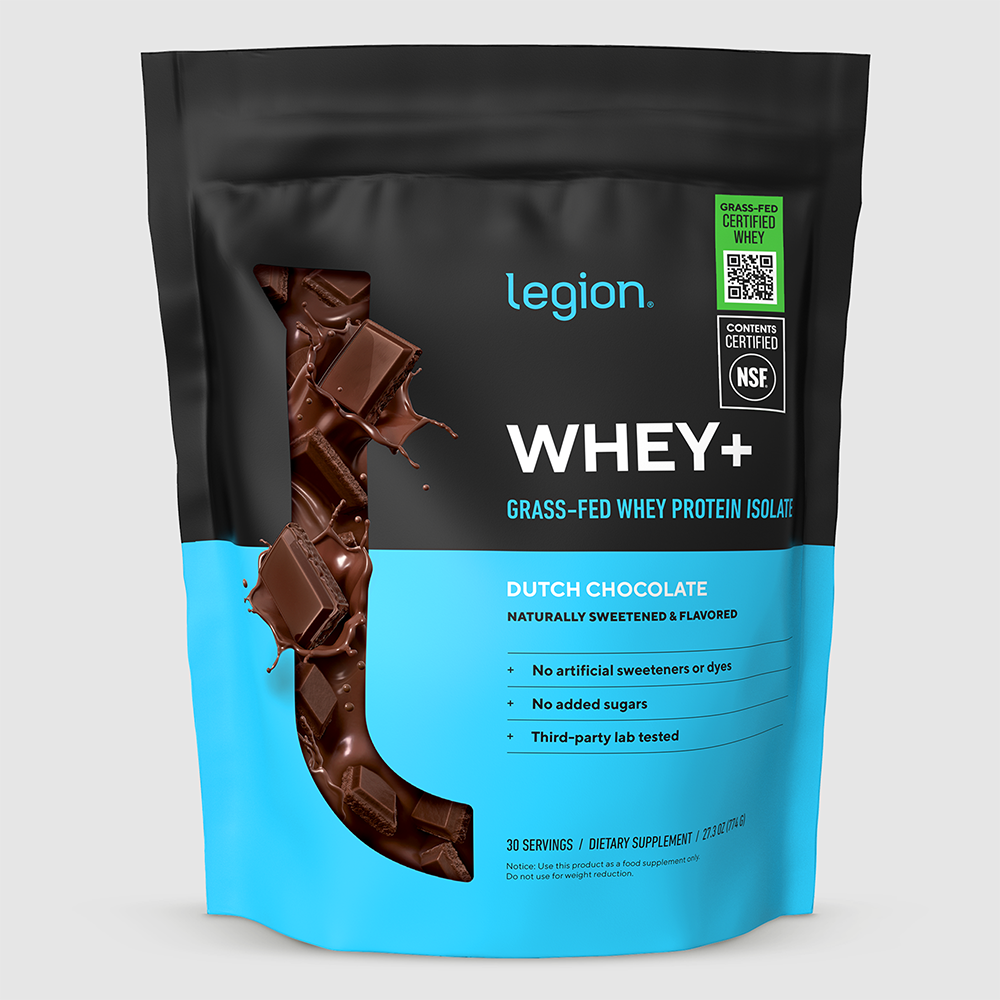
9.4/10 safety
COALegion
Whey+ Whey Protein Powder
Varies · 1 scoop serving
Best for · #5 lowest heavy metals of 34 rated
Lead: too small to measure
22.5 g protein per scoop · Complete protein
$54.99 · updated 22 Nov
Lab details & evidence ▾
Heavy metals
µg/serving · independent test, not scored. ND = not detected; below LOQ = too small to measure; iAs = inorganic arsenic.
Metals score 9.4/10 · measured against Prop 65 (California's daily safe limit)
Brand-published test: Legion COA, lot 2623152: Cd 0.01 ppm × 26 g; Pb/As (<0.01 ppm) and Hg (<0.001 ppm) below LOQ (counted as 0).
Protein quality
Complete
- Limiting amino acid:
- None (histidine is the closest to the reference level)
- Metric:
- DIAAS 1.09 · PDCAAS 1.00 (DIAAS/PDCAAS are lab scores for protein quality; 1.0 is the top)
- Rich in:
- Leucine 2.41 g, lysine 2.34 g, threonine 1.56 g per serving; 5.6 g BCAAs, 12 g EAAs (brand data)
- Low in:
- None below reference; histidine is the lowest relative to need
Source: Brand data (amino-acid profile on product page) · score basis: Typical for whey protein isolate (published studies: DIAAS 1.09, PDCAAS 1.00, Rutherfurd et al. 2015)
- Protein:
- Whey isolate (grass-fed)
- Completeness:
- Complete — Whey isolate; complete (PDCAAS 1.0).
- Completeness score:
- 10.0/10 — typical value for whey protein isolate (DIAAS 1.09, Rutherfurd et al. 2015, J Nutr 145:372)
Sources
- Independent test (not scored):
- Labdoor / third-party lab COA (ICP-MS) · checked 2026-03-06
- Evidence:
- Labdoor review 6 Mar 2026: 22.5 g protein measured vs 22 g claimed; lead, cadmium, arsenic and mercury all below limit of quantification. Not quantified ≠ zero; methods differ from CR.
- Price:
- ≈ $1.90/serving · 11.8 g protein per $ (approx., verify at checkout)
Related articles
Protein powder without heavy metals: what “zero metals” actually means
2026-11-15
No lab can prove a scoop is metaphysically metal-free. ND and below-LOQ results still beat vague “clean” claims — here are the powders that publish the tightest brand panels against Prop 65 MADLs.
Protein bars vs powder: which format is cleaner on heavy metals?
2026-11-11
Clean Label Project’s 2025 snack/nutrition bar study found detectable heavy metals in every bar tested, with about 22% over Prop 65 lead. Consumer Reports’ powder/shake round is a different format. When a scoop with a lot COA is the cleaner daily default.
“Heavy metals tested” on protein powder: what the claim actually means
2026-11-13
“Heavy metals tested” on a tub or Amazon bullet is not the same as a lot-matched certificate of analysis with lead, cadmium, arsenic and mercury in µg per serving. Here is how to tell marketing from usable lab maths.
As an Amazon Associate I earn from qualifying purchases. Affiliate status never changes rank. 0 paid placements.